(By Faraz Ahmed)
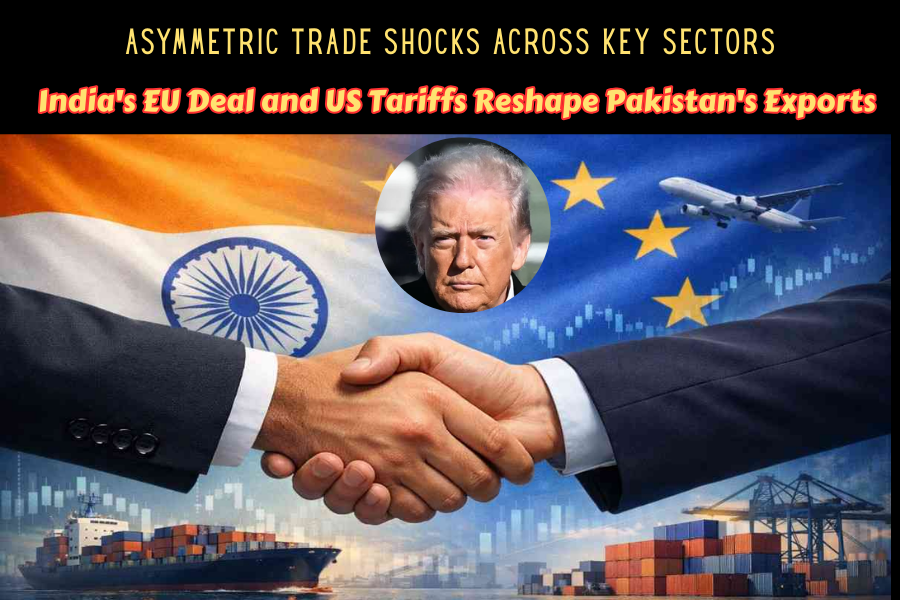
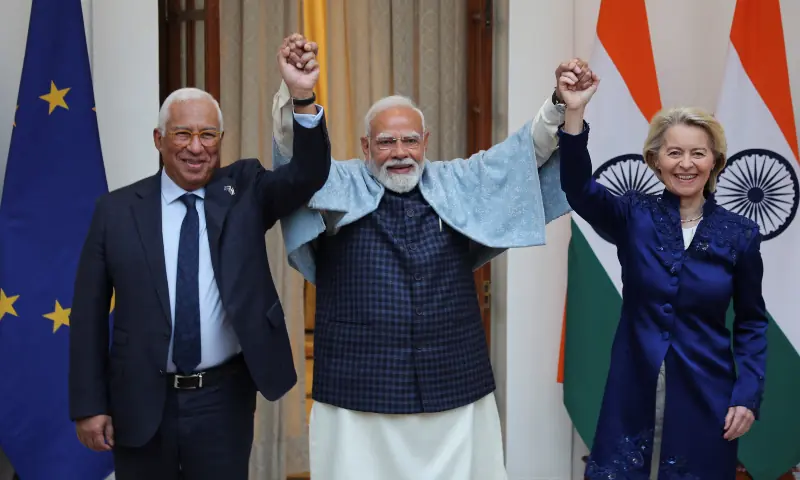
The conclusion of the India-European Union Free Trade Agreement (FTA) on January 27, 2026, during the 16th India-EU Summit in New Delhi marks a pivotal moment in global trade dynamics. Dubbed the “mother of all deals” by European Commission President Ursula von der Leyen and Indian leaders, the pact creates preferential access across a market encompassing nearly 2 billion consumers and roughly 25% of global GDP. For India, it promises accelerated export growth in labour-intensive and high-value sectors. For Pakistan, a key competitor in several overlapping categories, it introduces significant competitive headwinds—particularly in the EU, Pakistan’s second-largest export destination.
Compounding this is the US tariff regime under the current administration, where India faces an effective average of around 50% (including reciprocal rates and a 25% penalty linked to Russian oil imports), while Pakistan encounters a comparatively lighter ~19%. This differential provides Pakistan with a temporary edge in the American market, the country’s top or near-top destination depending on the year.
Pakistan’s exports to the EU stood at approximately $9.01 billion in 2024 (accounting for about 27-28% of total exports), while shipments to the US reached $5.61 billion. Textiles and apparel remain the cornerstone (often 70-80% in both markets), but diversification into leather goods, surgical/medical instruments, carpets and floor coverings, gems and jewellery, rice and other agro-products, and—crucially—IT and digital services adds resilience. This article delves into the mechanics of these trade shifts, their sector-specific impacts, the potential for US gains to offset EU losses, and actionable strategies for Pakistani exporters.
The India-EU Free Trade Agreement: Key Provisions and Timeline
Negotiations for the India-EU FTA, initially launched in 2007, stalled for years before being relaunched in 2022 and concluding swiftly in early 2026. The agreement features:
- Tariff reductions on 90-99% of trade lines by value: The EU provides immediate or phased zero-tariff access for most Indian exports, including textiles, apparel, leather, footwear, gems and jewellery, handicrafts, carpets, and engineering goods.
- Reciprocal concessions from India: Phased elimination or cuts on ~93-97% of EU exports, such as automobiles (duties dropping from up to 110% to ~10%), wines/spirits (from 150% to 40%), olive oil, machinery, chemicals, and pharmaceuticals.
- Additional elements: Provisions on intellectual property, sustainable development, and geographical indications (GIs), with parallel talks ongoing for investment protection.
- Implementation timeline: Formal signing after legal scrubbing (expected in 5-6 months), with full effects likely from late 2026 or early 2027.
This grants India more unconditional and comprehensive access than Pakistan’s GSP+ scheme, which offers duty-free entry on ~66-88% of lines but ties benefits to stringent compliance in human rights, labour, environment, and governance—adding administrative and cost burdens.
Pakistan’s Export Profile to EU and US: A Multi-Sector Snapshot
Pakistan’s trade with these partners is goods-heavy but shows emerging service strength.
To the EU (2024: ~$9.01 billion total goods imports from Pakistan):
- Textiles/apparel and made-up articles (bedlinen, towels, knit/non-knit garments, etc.): ~75-80% (~$6-7 billion, including $2.24 billion in other made textile articles).
- Leather articles and goods: ~$319 million.
- Cereals (primarily husked/brown rice): Significant, often in the hundreds of millions.
- Carpets and textile floor coverings: ~$26 million.
- Surgical/medical instruments, gems/jewellery, and engineering goods: Smaller but established shares (e.g., surgical goods from Sialkot hubs).
- IT/services: Not dominant in goods stats but growing; Pakistan’s global IT exports hit records like $437 million monthly in December 2025, with portions flowing to EU nations (Germany, Netherlands) via software development, BPO, and freelancing.
To the US (2024: ~$5.61 billion goods):
- Textiles/apparel (house linens ~$954-1 billion+, knit/non-knit garments): ~70-80% (~$3-4 billion).
- Surgical/optical/medical instruments: ~$110-413 million (strong niche from Sialkot).
- Leather articles: ~$171 million.
- Carpets/floor coverings: ~$34 million.
- Gems/jewellery and other manufactures: Minor.
- IT/services: Major destination for Pakistan’s booming IT sector (~$3-4+ billion annually globally, with records like $437 million in Dec 2025; US clients drive much of freelance/software/BPO growth).
IT/services remain largely tariff-immune due to digital delivery and WTO/GATS frameworks.
Pakistan Exports to EU and US in 2024 (Billion USD)
EU |█████████████████████████████████████ $9.0B
US |███████████████████████ $5.61B
Scale: Each █ represents ≈ $0.25 billion
Threats from the India-EU FTA Across Sectors
The FTA erodes Pakistan’s GSP+ tariff preferences by granting India similar or superior access.
- Textiles, apparel, and leather: Highest vulnerability—India secures zero-tariff on nearly all lines (previously facing 8-12% duties). Analysts (including JS Global, Pakistan Textile Council, and Ministry of Commerce assessments) warn of 5-10%+ market share erosion, potentially costing $450-900 million+ annually in textiles alone, with ripple effects on jobs and forex.
- Gems & jewellery, handicrafts, and carpets: Labour-intensive and price-sensitive; India’s scale, vertical integration, and zero-tariff entry heighten competition, threatening smaller Pakistani shares.
- Surgical/medical instruments and engineering goods: Sialkot’s precision cluster remains competitive on quality/compliance, but Indian expansion could pressure margins in overlapping EU segments.
- Agro-products (e.g., rice): Rice often excluded or sensitively handled (e.g., no liberalization on milled rice due to EU food safety concerns); husked/brown basmati sees limited direct impact, though broader agri shifts possible.
- IT/services: Largely insulated—services provisions are lighter; EU access relies on digital trade rules rather than goods tariffs.
Pakistan’s GSP+ compliance costs exacerbate the challenge, while India’s deal offers streamlined entry.
US Tariff Regime: Relative Opportunities for Pakistan
US reciprocal tariffs (2025 onward) penalize deficits and geopolitics:
- India: ~50% average (baseline + 25% Russia-linked penalty).
- Pakistan: ~19% (lower deficit adjustment, no penalties).
This creates diversion potential:
- Textiles/leather/apparel: US importers may shift from pricier Indian sources, benefiting Pakistani bedlinen, garments, and leather.
- Surgical instruments, carpets, gems/jewellery: Niche edges in medical tools and floor coverings where overlap exists.
- IT/services: Unaffected by goods tariffs; US remains a prime market for Pakistani digital talent, fueling record monthly highs.
Modest stability or gains appear in recent US import data amid India’s higher barriers.
Assessing Offset Potential: Can US Gains Balance EU Losses?
The math suggests partial, not full, compensation:
- EU goods exposure (~$9 billion, textiles/leather dominant) exceeds US (~$5.6 billion).
- Optimistic US diversion (10-20% growth in competitive categories) could yield $300-800 million extra annually—helpful for textiles, surgical goods, and carpets.
- Constraints: Pakistan’s 19% US tariff still elevates costs vs. zero-duty FTA partners; rivals (Bangladesh/Vietnam ~20%) dilute advantages; smaller non-textile sectors limit upside.
- IT/services offer independent momentum (projected $4-4.5 billion+ annually by FY26 end), less tied to tariff plays.
Net effect: Valuable buffer in US-competitive goods and digital resilience, but structural EU pressure likely yields overall net negative for goods exports absent reforms.
Strategic Recommendations for Pakistan’s Export Diversification
Pakistan must act decisively:
- Short-term actions: Exploit US tariff gaps via targeted promotions, buyer outreach (e.g., for surgical instruments, carpets), and trade missions.
- Sector-specific strategies:
- Textiles/leather: Prioritize energy cost cuts, efficiency upgrades, and value addition (e.g., sustainable fabrics).
- Gems/jewellery/carpets: Enhance branding, certifications, and design innovation.
- Surgical/medical: Bolster Sialkot compliance for premium US/EU positioning.
- IT/services: Scale incentives (freelancer support, skills programs) to sustain 20%+ growth.
- Cross-cutting reforms: Reduce energy tariffs, improve logistics, safeguard GSP+ status, diversify to UK/Middle East/Africa, and monitor FTA/US developments.
In fragmented global trade, cost competitiveness and agility trump temporary advantages.
Conclusion
The India-EU FTA poses a formidable challenge to Pakistan’s goods exports—especially textiles, leather, gems, carpets, and related items—by neutralizing GSP+ preferences in Europe. US tariffs afford a relative shield and diversion opportunities, augmented by IT/services’ tariff-resilient boom. Yet, full offset remains elusive given scale differences and absolute barriers.
Pakistan’s diverse portfolio—from Sialkot’s surgical precision to digital freelancers—offers real pathways if supported by urgent reforms. As protectionism rises, turning trade shocks into catalysts for efficiency, diversification, and innovation will determine long-term export success. The window for adaptation is open—Pakistan must seize it to safeguard jobs, forex, and growth.