(By Khalid Masood)
India faces a significant dilemma in its dealings with the United States, particularly crystallized by the interim trade framework announced in early February 2026 between Prime Minister Narendra Modi and President Donald Trump. This stems from the fundamental tension between pursuing deeper economic and strategic ties with the world’s largest economy—for accelerated growth, technology access, supply chain diversification, and geopolitical leverage—and safeguarding India’s core principles of strategic autonomy, economic self-reliance (Atmanirbhar Bharat), protection of vulnerable domestic sectors like agriculture, and an independent foreign policy that avoids over-dependence on any single power.
The dilemma is stark: How far should India go in compromising its independence to secure tangible benefits from the US, especially when the relationship under the current administration has become highly transactional, with tariffs used as leverage and announcements often made unilaterally?
Background: The Evolving India-US Relationship
The India-US relationship has transformed since the early 2000s. From Cold War-era suspicion and non-alignment, it evolved into a comprehensive strategic partnership post-1998 nuclear tests and the 2008 civil nuclear deal. Key pillars include defense cooperation (via frameworks like COMCASA and BECA), the Quad (with Japan and Australia) to counter China in the Indo-Pacific, joint technology initiatives (e.g., iCET for semiconductors and AI), and growing economic ties.
Bilateral goods trade reached around $150–200 billion annually in recent years, with India enjoying a surplus (exports to US ~$80–90 billion/year vs. imports ~$40–57 billion). The US became India’s largest export market, absorbing key sectors like pharmaceuticals (generics), textiles, gems/jewelry, engineering goods, and IT services (though merchandise-focused here).
However, strains emerged under Trump’s second term. His “America First” approach emphasized reducing trade deficits, and India—seen as a high-tariff economy—faced pressure. Negotiations for a Bilateral Trade Agreement (BTA), launched in February 2025, dragged on amid disagreements over market access, tariffs, and non-tariff barriers.
The Imposition of 50% Tariffs: The Story and Its Impact
The crisis peaked in 2025. In August 2025, President Trump invoked the International Emergency Economic Powers Act (IEEPA) to impose an additional 25% tariff on Indian goods, layered atop an existing 25% reciprocal tariff, pushing effective duties to 50% on many imports from India. This punitive measure targeted India’s continued purchases of discounted Russian crude oil (which surged post-2022 Ukraine invasion, making Russia India’s top supplier at times).
The White House argued these imports indirectly funded Russia’s war efforts, and Trump explicitly threatened escalation unless India diversified away from Moscow. The tariffs, effective from late August 2025, applied broadly but hit labor-intensive and export-heavy sectors hardest: textiles/apparel, leather/footwear, plastics/rubber, organic chemicals, home décor, artisanal products, and machinery. Critical exemptions included pharmaceuticals, semiconductors, energy, and critical minerals, but over 55% of India’s ~$87 billion exports to the US in recent years faced the hike.
Impact on Indian Exports:
- Exporters faced immediate competitiveness loss. Apparel shipments to the US declined ~16% year-on-year in late 2025 (September–November), per industry estimates, as buyers shifted to lower-tariff alternatives like Bangladesh (20% tariffs) or Vietnam.
- Overall exports to the US stagnated or dipped slightly in late 2025/early 2026, with monthly figures showing pressure (e.g., December 2025 exports to US fell ~1.8% while surging to China as a workaround).
- MSMEs—key in textiles, leather, and gems—suffered cash flow issues, delayed orders, and job risks. The rupee weakened amid foreign outflows, and India’s stock market underperformed emerging peers in 2025 partly due to tariff uncertainty.
- Broader economy felt the pinch: The US market, vital for ~2.5% of India’s GDP via exports, saw reduced momentum, forcing diversification efforts (e.g., to EU via new FTA talks).
The tariffs created a deadlock, with India rejecting “punitive” measures and defending its energy choices as pragmatic (cheaper Russian oil helped control inflation and fuel subsidies).
The February 2026 Interim Trade Framework: A Reset
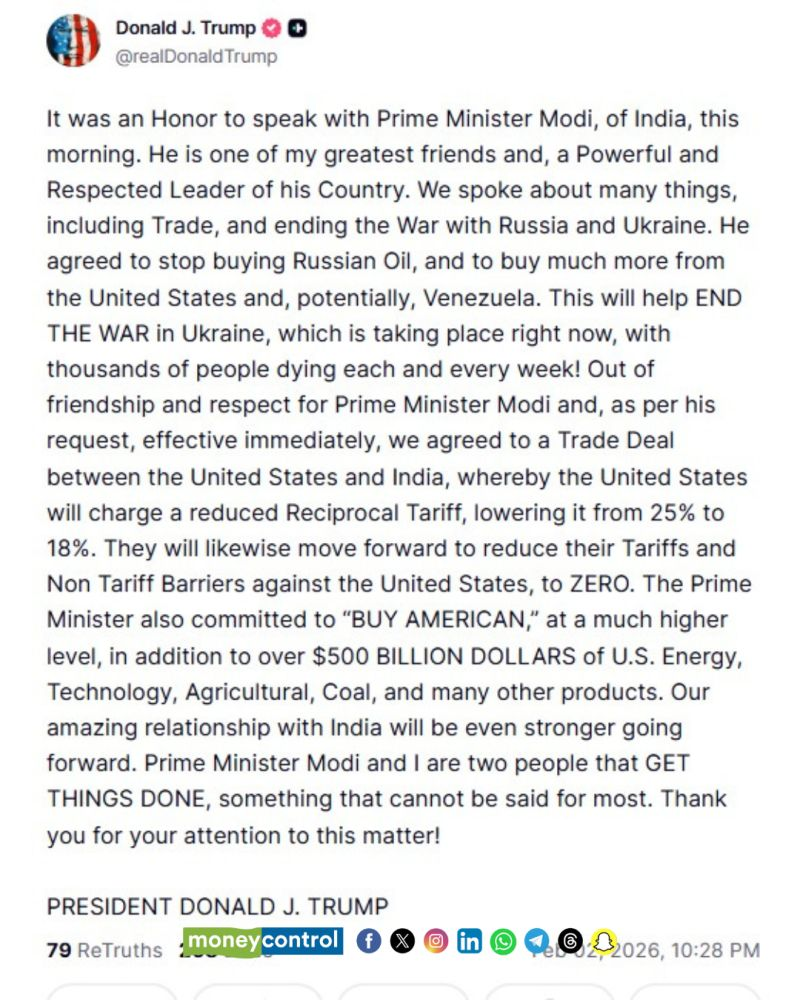
After months of back-channel talks and a Modi-Trump call in early February 2026, Trump announced on Truth Social a deal slashing US tariffs to 18% (removing the 25% punitive layer entirely). A joint statement on February 6–7 formalized an interim framework toward a fuller BTA.
Key elements:
- US side: Reciprocal tariff reduced to 18% on Indian goods (textiles, apparel, leather, plastics, chemicals, etc.); zero tariffs post-finalization on generics pharma, gems/diamonds, aircraft parts.
- India side: Eliminate/reduce tariffs on all US industrial goods and wide range of agri/food products (e.g., dried distillers’ grains, red sorghum, tree nuts, fruits, soybean oil, wine/spirits); address non-tariff barriers.
- Energy shift: India committed to halting direct/indirect Russian oil imports (US monitoring with reimposition threat if resumed); intent to buy more US/Venezuelan oil.
- Purchasing intent: India expressed intention to purchase $500 billion worth of US goods over five years (2026–2030), focusing on energy (oil, LNG, coal), aircraft/parts, technology (e.g., GPUs for AI), precious metals, and agriculture.
The government hailed it as “historic,” opening a “$30 trillion market” (US GDP reference), boosting “Make in India,” creating jobs (hundreds of thousands projected), and enhancing supply chain resilience.
The $500 Billion Imports Commitment: Details and Implications
The $500 billion figure—averaging $100 billion/year—is not a binding quota but a stated “intention” and “best endeavor” in the joint statement (Trump emphasized “BUY AMERICAN” at higher levels). It targets specific categories: energy products, aircraft, tech, coal, agriculture.
Current Baseline:
- India’s annual imports from US: ~$40–57 billion (e.g., ~$57 billion in FY 2024-25, driven by crude petroleum, coal, gold, aircraft).
- To reach $500 billion cumulatively, imports must roughly double from recent highs or triple from lower years—a 100–150%+ annual surge initially.
Detailed Implications:
- Economic Strain: India’s total global imports are ~$600–700 billion/year. Shifting ~$100 billion annually to US sources (often costlier than Russia/Middle East for oil) could inflate the import bill, widen trade deficits if exports don’t match, and pressure forex reserves/inflation.
- Sectoral Shifts:
- Energy: Increased US LNG/crude/coal could diversify away from Russia (imports already dipped in late 2025 due to prior pressures), but at higher costs; potential stability in supply but retail fuel price risks.
- Aircraft/Tech: Big-ticket Boeing orders or AI hardware could add billions lumpy; supports defense/modernization but increases dependence.
- Agriculture: Lower duties on US farm goods (soybean oil, nuts, fruits) could benefit consumers/processors (cheaper inputs) but threaten farmers if volumes surge.
- Trade Balance Risk: India enjoys a surplus with US (~$45–50 billion). Massive import ramp-up without proportional export growth could flip it to deficit, reducing bargaining power.
- Feasibility: Experts call it a “stretch goal”—possible with energy surges and mega-deals, but unlikely without policy push; historical growth (e.g., +40% in some years) shows potential, but 900% cumulative jump from ~$50 billion baseline is outlier.
- Sovereignty/Strategic: Ties energy policy to US demands; monitoring clause risks re-tariffs if Russia ties resume, limiting multi-alignment.
The Strategic Autonomy Dilemma
India’s foreign policy prioritizes multi-alignment—strong US ties for tech/security, Russia for defense/energy, others for balance. The deal’s transactional nature (tariffs as coercion) forces choices: deeper alignment for gains or risk penalties/isolation. This could constrain flexibility in global conflicts, energy security, and independent decisions, fueling “capitulation” perceptions.
Domestic Political Debate and Opposition Criticism
The framework ignited fierce parliamentary uproar. Opposition (Congress-led) staged walkouts, displayed “US India Trap Deal” posters, and disrupted sessions, preventing full statements.
Congress criticisms:
- “Surrender” or “grave deal”—Modi “completely surrendered” to Trump via “huglomacy” (personal diplomacy over national interest).
- Lack of transparency: Deal announced by Trump first; no full text tabled; demands for clause-by-clause debate.
- Farmer harm: Zero-duty US agri access floods markets, hurts locals; turns surplus to deficit.
- Sovereignty erosion: External dictation on Russian oil; bypasses Parliament.
- Leaders like Jairam Ramesh, Rahul Gandhi, Manish Tewari called it “order from Washington,” warning of compromised autonomy.
Government countered: Pragmatic, protects sensitive agri (e.g., wheat, rice, dairy exemptions); ready for debate; boosts jobs/growth.
Broader Geopolitical Context
For the US: A “win” for workers/farmers, counters China via supply chains. For India: Middle-power bind—wants coalitions but wary of US unreliability (tariffs, visas). Future: Could evolve into fuller BTA, but depends on execution, avoiding over-dependence.
In conclusion, the interim framework offers real gains—tariff relief, market access, investments—but at the cost of potential dependencies, economic imbalances, and autonomy erosion. In a multipolar world, India needs to negotiate shrewdly, diversify partners (EU, ASEAN), and strengthen domestic capabilities to balance pragmatism with principled independence. The true test lies in implementation: Will benefits outweigh compromises, or will the dilemma deepen?