(Faraz Ahmed)
Introduction: The Dawn of a New Digital Era
On March 10, 2026, Pakistan crossed a historic threshold. The Pakistan Telecommunication Authority (PTA) concluded the nation’s first 5G spectrum auction, raising an impressive $507 million by selling 480 MHz of spectrum to the country’s leading telecom operators. While headlines celebrated the record-breaking revenue and the promise of lightning-fast download speeds, the real story runs far deeper.
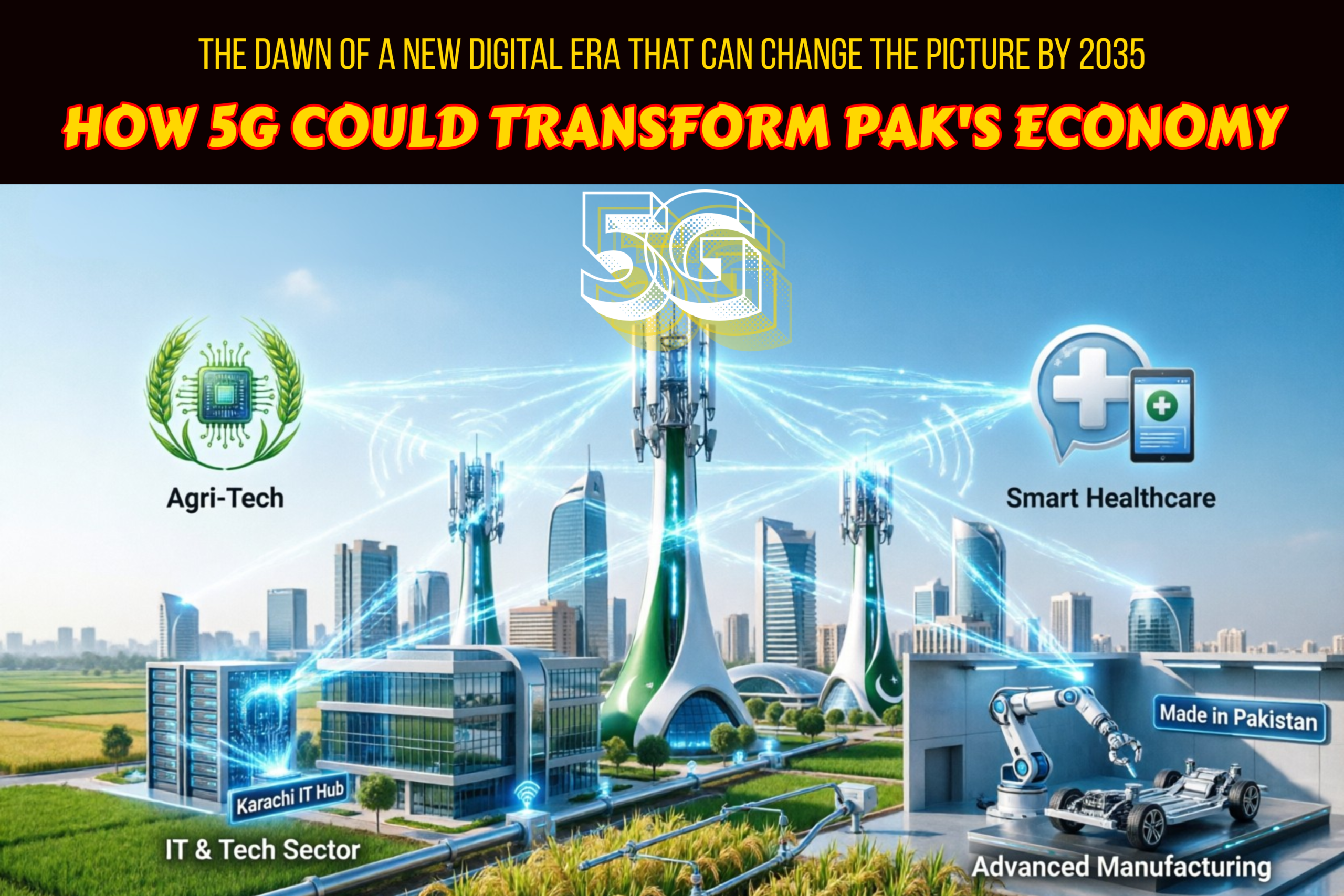
For Pakistan, 5G is not merely a telecom upgrade—it represents a foundational shift aimed at revitalizing key industries, boosting GDP, and integrating the nation into the global digital economy. As the country stands on the brink of commercial 5G launch (targeted for mid-2026), the question is no longer if this technology will transform Pakistan, but how and how quickly.
This article explores the economic potential of 5G beyond consumer convenience, examining how this next-generation network could reshape agriculture, healthcare, manufacturing, and the IT sector by 2035. We’ll also address the infrastructure challenges, policy frameworks, and realities that will determine whether Pakistan’s 5G vision becomes a catalyst for sustained economic growth.
The Launchpad: Auction Results & Operator Readiness
The successful conclusion of Pakistan’s 5G spectrum auction marks the beginning of a decade-long transformation journey. The PTA sold 480 MHz of spectrum across multiple frequency bands, with three major operators securing significant holdings:
| Operator | Spectrum Acquired | Key Bands |
|---|---|---|
| Jazz | 190 MHz | 700, 2300, 2600, 3500 MHz |
| Ufone | 180 MHz | 2600, 3500 MHz |
| Zong | 110 MHz | 2600, 3500 MHz |
Jazz emerged as the most aggressive bidder, acquiring spectrum across low, mid, and high bands—a strategy that will enable both wide rural coverage and high-capacity urban deployment. Ufone focused heavily on the 3500 MHz band, the global standard for 5G, while Zong secured a competitive position to maintain its market presence.
What makes this auction different?
Unlike previous spectrum sales, the PTA introduced several operator-friendly measures:
- One-year capital investment window: Operators can focus on infrastructure build-out before heavy spectrum payments begin
- Technology neutrality: Flexibility to deploy any IMT technology within the policy framework
- Spectrum sharing and trading: Allows operators to optimize utilization and reduce waste
- 15-year license validity: Provides long-term planning certainty
With commercial launch targeted for mid-2026, operators now face the race to build infrastructure. The initial rollout will cover Pakistan’s five largest cities: Islamabad, Karachi, Lahore, Peshawar, and Quetta.
Economic Engine: Sector-Specific Transformations
🌾 Smart Agriculture: Feeding the Future
Agriculture contributes approximately 23% of Pakistan’s GDP and employs nearly 40% of the workforce. Yet the sector remains plagued by outdated practices, water scarcity, and low yields. 5G-enabled precision agriculture could change this equation dramatically.
How 5G transforms farming:
- IoT sensors embedded in fields can monitor soil moisture, nutrient levels, and crop health in real-time
- Automated irrigation systems respond instantly to weather data, conserving precious water resources
- Drone-based crop monitoring provides high-resolution imagery for early pest and disease detection
- Supply chain tracking ensures produce reaches markets faster with reduced spoilage
For a country facing chronic water shortages and food security challenges, 5G-powered smart agriculture isn’t just an efficiency gain—it’s a necessity. Early pilots in Punjab and Sindh have already shown yield improvements of 15-20% with IoT-enabled farming. By 2035, widespread adoption could add billions to agricultural output while reducing resource waste.
🏥 Healthcare & Telemedicine: Bridging the Urban-Rural Divide
Pakistan’s healthcare system faces a stark urban-rural divide. Major cities boast world-class hospitals, while rural areas struggle with basic medical access. 5G’s ultra-low latency and high bandwidth can help bridge this gap.
5G healthcare applications:
- Remote surgeries: Specialists in Karachi or Lahore can perform procedures on patients in remote villages using robotic systems
- Real-time patient monitoring: Wearable devices transmit vital signs continuously to healthcare providers
- Teleconsultations: High-definition video calls enable accurate diagnosis without travel
- Medical imaging: Large files (MRIs, CT scans) transfer instantly for second opinions
The PTA’s 5G Security Guidelines 2025 mandate end-to-end encryption and data privacy standards—critical for protecting sensitive health information. By 2035, telemedicine powered by 5G could serve millions of Pakistanis who currently lack access to quality healthcare, reducing mortality rates and healthcare costs simultaneously.
🏭 Industrial Automation & Manufacturing: Industry 4.0 Arrives
Pakistan’s manufacturing sector has long struggled with productivity gaps compared to regional competitors. 5G enables Industry 4.0—the integration of cyber-physical systems, IoT, and AI in manufacturing.
Transformative applications:
- Predictive maintenance: Sensors detect equipment failures before they occur, reducing downtime
- Automated robotics: 5G’s low latency enables precise robotic control in assembly lines
- Quality control: AI-powered cameras inspect products in real-time with near-zero defects
- Supply chain optimization: Real-time tracking from raw materials to finished goods
The recent local production of 500,000–600,000 5G-enabled smartphones demonstrates Pakistan’s growing manufacturing capabilities. With 5G infrastructure, similar advances could spread to textiles, automotive, and electronics manufacturing—sectors that employ millions and drive exports.
The Digital Ecosystem: IT, Freelancing & Startups
💻 Boosting IT Exports
Pakistan’s IT and IT-enabled services sector has grown steadily, reaching $2.6 billion in exports in recent years. However, unreliable connectivity has limited the types of projects Pakistani firms can undertake. 5G changes this.
What 5G enables for IT:
- Cloud-native development: Developers can work seamlessly with cloud-based tools and infrastructure
- Complex projects: Video processing, AI/ML workloads, and real-time applications become feasible
- Global collaboration: High-quality video conferencing and screen sharing with international clients
- Data centers: 5G backhaul supports expansion of local data center capacity
Industry analysts project that reliable 5G connectivity could help Pakistan’s IT exports double or triple by 2035, positioning the country as a regional technology hub alongside India and Bangladesh.
🎯 The Freelance Economy
Pakistan ranks among the top five countries globally for freelance workers, with hundreds of thousands earning income through platforms like Upwork, Fiverr, and Toptal. For freelancers, connectivity isn’t a luxury—it’s their livelihood.
5G benefits for freelancers:
- Uninterrupted workflows: No more dropped calls or frozen video conferences with clients
- Large file transfers: Video editors, designers, and developers can send work instantly
- Multiple device connectivity: Laptops, tablets, and phones all stay connected simultaneously
- Remote work flexibility: High-speed internet anywhere in covered areas
For Pakistan’s massive youth population, 5G could unlock unprecedented access to the global gig economy—creating jobs without requiring emigration or traditional office employment.
📱 Local Manufacturing Boom
The production of 500,000+ locally manufactured 5G smartphones is just the beginning. As 5G adoption grows, demand for compatible devices will surge, creating opportunities for:
- Device assembly and manufacturing
- Component supply chains
- Software and app development
- Network equipment and infrastructure
This ecosystem could generate tens of thousands of jobs while reducing Pakistan’s reliance on imported technology—a critical consideration for a country facing foreign exchange constraints.
The Roadmap to 2035: Infrastructure & Policy
Pakistan’s 5G rollout follows a phased, decade-long strategy designed to balance ambition with practicality:
📅 Phase-wise Expansion Plan
| Period | Coverage | Infrastructure Targets |
|---|---|---|
| 2026-27 | Federal & provincial capitals | 1,000 sites/year, 20% fiberization |
| 2028-29 | +10 cities | 1,000 sites/year, 25% fiberization |
| 2030-31 | +10 more cities | 1,000 sites/year, 30% fiberization |
| 2032-35 | +15 additional cities | 1,000 sites/year, 35% fiberization |
📊 Performance Targets
- 4G minimum speeds: 20 Mbps (2026-27) → 50 Mbps (2030-35)
- 5G minimum speeds: 50 Mbps (initial) → 100 Mbps (by 2035)
- Latency reduction: Significant improvements for real-time applications
- Network reliability: Mandatory uptime and quality standards
🛡️ Regulatory Framework
The PTA has established a comprehensive policy environment to support 5G deployment:
- Technology Neutrality: Operators can deploy any IMT technology within the framework
- Security Guidelines 2025: Mandatory encryption, authentication, and data protection
- Spectrum Caps: 40% maximum per operator to ensure fair competition
- Compliance Enforcement: Non-compliant bids rejected during auction process
This regulatory clarity provides investors and operators the confidence needed for long-term infrastructure investments.
Reality Check: Challenges to Overcome
While the 5G vision is compelling, Pakistan faces significant hurdles that could slow or limit transformation:
⚡ Infrastructure Gaps
Fiberization: Pakistan’s fiber network remains underdeveloped. The 20-35% fiberization targets by 2035 require massive investment in backbone infrastructure. Without adequate fiber, 5G towers cannot deliver promised speeds.
Power Supply: Telecom towers require consistent electricity. Pakistan’s ongoing energy challenges could increase operational costs and cause network outages—undermining 5G reliability.
💰 Affordability & Adoption
Device Costs: 5G-enabled smartphones remain expensive for average Pakistani consumers. While local manufacturing helps, widespread adoption requires prices to drop significantly.
Data Pricing: 5G plans will likely carry premium pricing initially. If costs remain high, adoption will be limited to urban elites, slowing economic impact.
🌍 The Digital Divide
The initial rollout focuses on five major cities. Rural areas—home to over 60% of Pakistan’s population—may wait years for 5G coverage. Without deliberate policy intervention, 5G could widen the urban-rural digital divide rather than bridge it.
🔒 Security Concerns
Expanded connectivity brings expanded vulnerabilities. The PTA’s security guidelines are comprehensive, but implementation and enforcement remain challenges. Public trust in 5G security will affect adoption rates, particularly for sensitive applications like telemedicine and financial services.
Conclusion: A Vision for 2035
Pakistan’s entry into the 5G era represents more than a technological milestone—it’s an economic opportunity that could define the nation’s trajectory for the next decade. The $507 million spectrum auction is just the down payment on a transformation that could add billions to GDP by 2035.
The potential is clear:
- Agriculture becomes smarter, more efficient, and more sustainable
- Healthcare reaches millions currently underserved
- Manufacturing competes globally through automation and quality
- IT and freelancing sectors unlock their full export potential
- Local technology manufacturing creates jobs and reduces imports
But potential alone doesn’t guarantee success. Pakistan’s 5G journey will be determined by:
- Infrastructure investment (fiber, power, towers)
- Affordability (devices and data plans)
- Inclusive rollout (urban and rural coverage)
- Security and trust (data protection and privacy)
By 2035, Pakistan could emerge as a regional digital hub—or it could find itself with expensive infrastructure serving only a privileged few. The difference lies in execution.
For policymakers, the message is clear: 5G is not a telecom project; it’s an economic development strategy. For businesses, it’s a signal to prepare for digital transformation. For consumers, it’s an invitation to participate in a connected future.
Pakistan stands at a crossroads. The spectrum has been auctioned. The roadmap is drawn. The question now is whether the nation can mobilize the resources, political will, and public-private collaboration needed to turn 5G promise into economic reality.
The next decade will tell.