(By Khalid Masood)
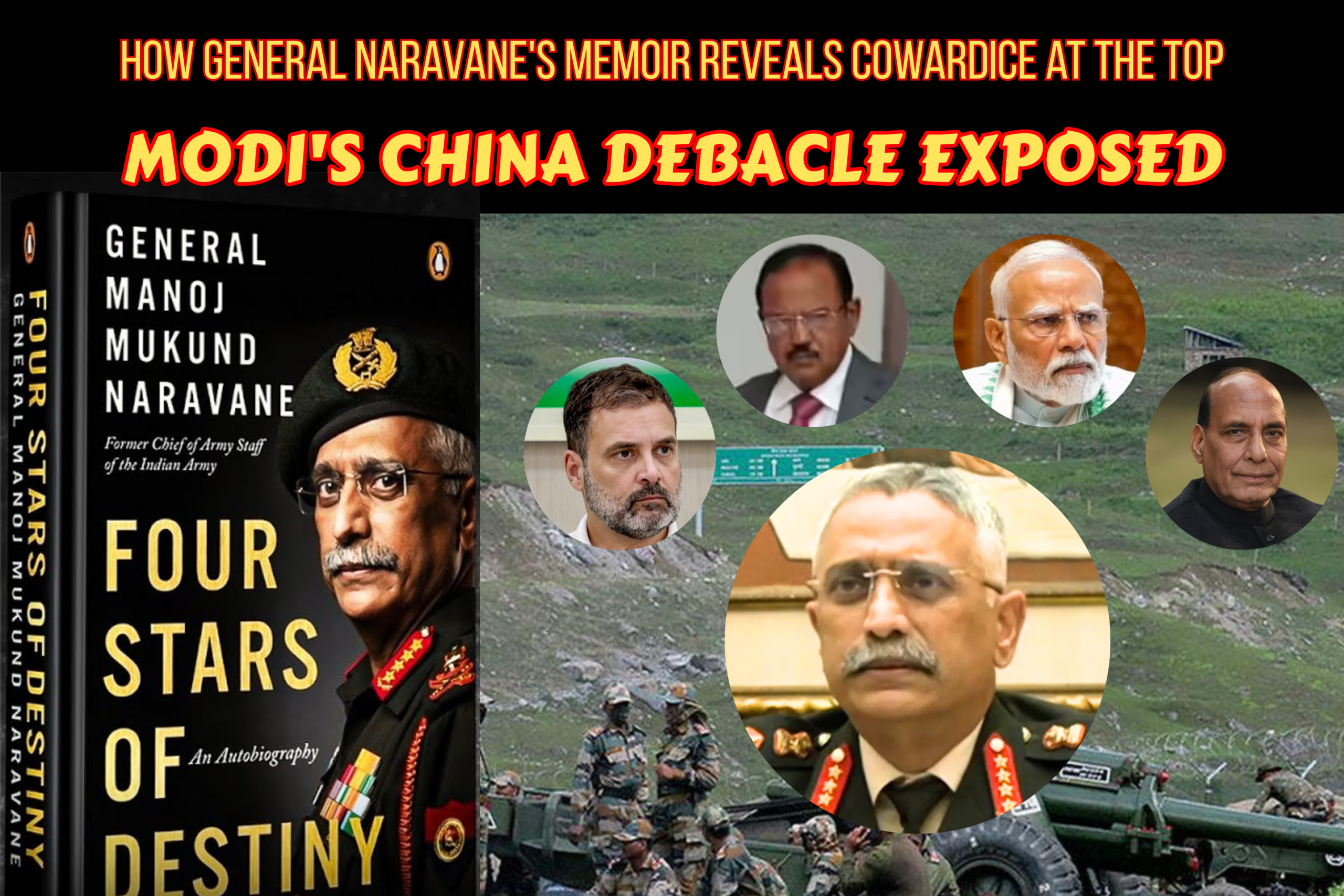
The controversy surrounding former Indian Army Chief General M.M. Naravane’s memoir, titled Four Stars of Destiny, has erupted into one of the most significant political storms in India’s Parliament in recent months. As of February 10, 2026, the book remains unpublished, having been submitted for mandatory government clearance from the Ministry of Defence and Army Headquarters in 2024 under established protocols for retired senior military officers. These rules require review of any content that might disclose sensitive operational details or impact national security.
Despite the book’s official status as unpublished, excerpts from its manuscript—first published in a detailed essay by Sushant Singh in The Caravan magazine on January 31, 2026—have triggered widespread debate, parliamentary disruptions, accusations of suppression, and a formal police investigation. The revelations focus primarily on the handling of the 2020 India-China military standoff in eastern Ladakh, raising questions about political decision-making, command responsibility, and the gap between public narratives and on-ground realities during a critical national security crisis.
The Memoir’s Background and Core Revelations
General Manoj Mukund Naravane served as Chief of the Army Staff from December 2019 to November 2022, a period that encompassed the most serious border confrontation with China since the 1962 war. Four Stars of Destiny is described as a comprehensive memoir blending personal reflections, career insights, and accounts of key events, including the Ladakh standoff that began in May 2020.
The most contentious sections, as excerpted in The Caravan, center on the night of August 31, 2020. Northern Army Commander Lieutenant General Y.K. Joshi informed Naravane that four Chinese People’s Liberation Army (PLA) tanks, supported by infantry, were advancing along a steep mountain track toward Rechin La in eastern Ladakh. This movement directly threatened Indian positions on the Kailash Range heights—strategic high ground that Indian forces had seized earlier that month in a pre-emptive operation to counter Chinese advances.
In high-altitude terrain like this, control of dominating heights provides overwhelming tactical advantages, including better observation, fire support, and defensive positioning. Naravane recognized the gravity immediately and initiated a series of urgent calls to top civilian and military leaders: Defence Minister Rajnath Singh, National Security Advisor Ajit Doval, Chief of Defence Staff General Bipin Rawat, and External Affairs Minister S. Jaishankar.
Naravane’s repeated question during these communications was straightforward: “What are my orders?” A standing protocol, rooted in long-standing confidence-building measures between India and China, prohibited the use of firearms along the Line of Actual Control (LAC) without explicit high-level authorization, and firing on forces entering disputed areas required top clearance to avoid unintended escalation.
According to the excerpts, no clear, decisive directive emerged. After multiple exchanges, Defence Minister Rajnath Singh relayed a message attributed to Prime Minister Narendra Modi: “Jo uchit samjho, woh karo” (do whatever you deem appropriate). Naravane describes this as leaving him in an untenable position—feeling “really alone” and “completely abandoned by the entire establishment.” He characterizes the situation as being handed a “hot potato,” with field commanders pressing for action while political leadership offered ambiguity rather than guidance. The standoff at Rechin La lasted over two hours, with Chinese armor closing to within a few hundred meters before eventual de-escalation.
The memoir places this incident within the broader context of the 2020 Ladakh crisis, which saw simultaneous incursions at multiple points along the LAC, including Galwan Valley, Pangong Lake, Hot Springs, and Depsang Plains. It references the deadly June 15, 2020, clash in Galwan Valley, where troops engaged in brutal hand-to-hand combat using clubs, stones, and improvised weapons (adhering to the no-firearms agreement), resulting in 20 confirmed Indian deaths and reported Chinese casualties—the first fatalities on the border since 1975.
Naravane’s account contrasts sharply with the government’s repeated public assertion that “not an inch of land was lost” and that Indian forces responded effectively. The excerpts suggest systemic challenges in real-time crisis management, including perceived gaps in political direction and the burden placed on military leadership amid high-stakes uncertainty.
The Political Explosion in Parliament
The controversy ignited in the Lok Sabha during the Budget session in early February 2026, specifically while debating the Motion of Thanks to the President’s Address. Leader of Opposition Rahul Gandhi attempted to quote passages from The Caravan essay, which included direct excerpts from the memoir. He argued that the content revealed critical details about the 2020 handling and accused the government of suppressing uncomfortable truths.
Treasury benches reacted immediately and forcefully. Defence Minister Rajnath Singh, Home Minister Amit Shah, and Parliamentary Affairs Minister Kiren Rijiju led objections, asserting that referencing an “unpublished” book violated parliamentary rules and could endanger national security. The Speaker invoked provisions such as Rule 349 (which restricts references to matters sub judice or unpublished sensitive material) and related guidelines to block the quotes.
The interruptions escalated into repeated adjournments of the House—multiple times in a single day—heated exchanges, and the eventual suspension of several Opposition MPs. Gandhi maintained his position, arguing that the excerpts were already in the public domain via a reputable magazine and that preventing discussion amounted to evasion.
Outside Parliament on February 4, 2026, Gandhi escalated the drama by displaying what appeared to be a printed copy of the memoir. He declared it proof of the book’s existence, contrary to government claims that it “does not exist.” He stated his intent to personally hand a copy to Prime Minister Modi if the latter attended the Lok Sabha, accusing the leadership of fearing the revelations. Gandhi emphasized that the excerpts showed the Prime Minister and Defence Minister had “not fulfilled their responsibility” during the crisis, leaving the Army Chief isolated.
The episode drew widespread media coverage, with Opposition parties amplifying calls for transparency and accountability, while the ruling BJP framed the references as misleading, an insult to the armed forces, and an attempt to politicize national security.
Publisher’s Position and the Ongoing Investigation
Penguin Random House India, which holds exclusive publishing rights to Four Stars of Destiny, issued a detailed clarification on February 9, 2026. The statement emphasized that the book has “not gone into publication” in any form—no print or digital copies have been published, distributed, sold, or made available to the public by the publisher. It warned that any circulating versions (including PDFs shared via WhatsApp and other informal channels, often among military and veteran networks) constitute unauthorized dissemination and copyright infringement. The publisher threatened legal action to protect its rights and prevent further circulation.
This came amid reports that pre-print typeset or manuscript versions had leaked, possibly during the clearance process or editorial stages. Delhi Police registered a First Information Report (FIR) to investigate the source and spread of these unauthorized copies, treating the matter as involving potential copyright violations and security implications.
The selective targeting of this memoir—while other books by retired officers have cleared similar scrutiny—has fueled speculation about why clearance remains pending after over a year. Naravane himself has not publicly commented on the current row, and the Ministry of Defence has maintained silence beyond standard procedural references.
Contextual Reference to Earlier Border Standoffs
To provide perspective on the 2020 crisis, it is useful to briefly reference the 2017 Doklam standoff—a 73-day confrontation at the India-China-Bhutan trijunction. Triggered by Chinese road construction in disputed territory claimed by Bhutan (but strategically sensitive to India due to proximity to the Siliguri Corridor), Indian troops intervened to halt the activity. No firearms were used, no casualties occurred, and the matter resolved through diplomacy, with mutual disengagement allowing normalcy to return, including Modi’s attendance at the BRICS summit in China shortly afterward.
In contrast, the 2020 Ladakh events were far more extensive: multi-sector incursions, lethal violence in Galwan, massive troop deployments (tens of thousands on each side), winter militarization, and protracted partial disengagements negotiated over multiple rounds of talks into subsequent years. While Doklam tested resolve in a contained manner, Ladakh exposed risks of lethality, prolonged tension, and challenges in crisis coordination—elements that Naravane’s memoir appears to address directly.
Broader Implications and Ongoing Debate
This controversy extends beyond one book. It highlights perennial issues in India’s border management: accelerating infrastructure competition on both sides, differing interpretations of the LAC, the fragility of confidence-building mechanisms, and the need for seamless political-military alignment during emergencies.
The pending clearance process for military memoirs raises questions about transparency versus security: how to balance the right of retired officers to share experiences with safeguards against sensitive disclosures. The parliamentary disruptions and suspensions underscore deepening political polarization, where national security becomes a battleground for narrative control.
As the investigation into the leak continues and public discourse evolves, the focus remains on the revelations from Four Stars of Destiny—particularly the August 31, 2020, episode—and their implications for understanding leadership during one of India’s most challenging border crises in decades. Whether the book eventually clears publication, and in what form, will likely shape future debates on accountability, civilian oversight of the military, and the handling of strategic challenges along the Himalayas.