(By Mohsin Tanveer)
Introduction
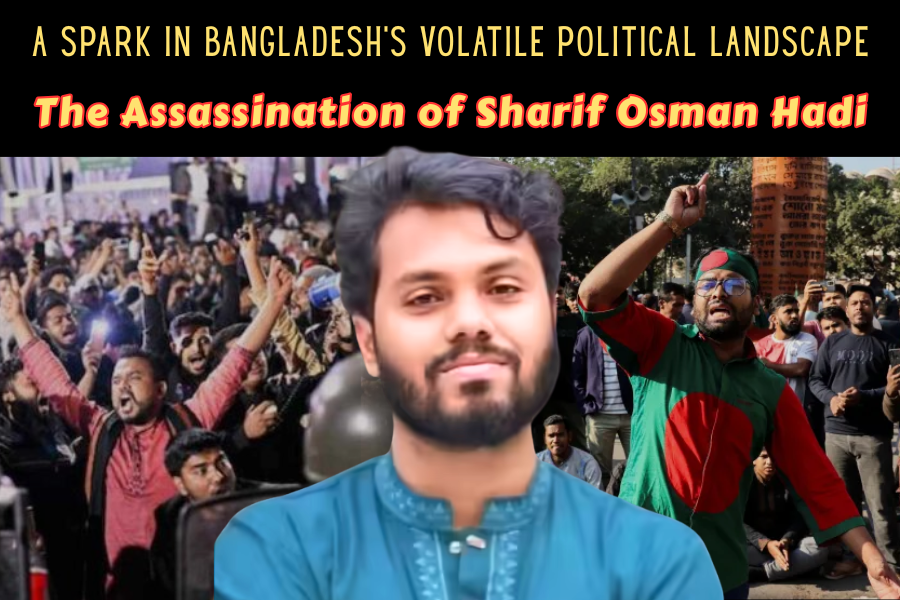
On December 18, 2025, Sharif Osman Hadi, a 32-year-old prominent youth leader and key figure in Bangladesh’s 2024 pro-democracy uprising, succumbed to injuries sustained in a targeted shooting in Dhaka six days earlier. His death has ignited widespread protests, violence, and a diplomatic row between Bangladesh and India, exacerbating tensions in a nation already grappling with political transition ahead of February 2026 elections. Hadi’s assassination has been described by Bangladesh’s interim government as a “premeditated attack” aimed at derailing the democratic process. While investigations point to local suspects, unverified allegations of involvement by India’s Research and Analysis Wing (RAW) have fueled anti-India sentiments, though these remain speculative and denied by New Delhi.
Who Was Sharif Osman Hadi?
Sharif Osman bin Hadi rose to prominence during the 2024 student-led uprising that ousted long-time Prime Minister Sheikh Hasina and her Awami League government. As a spokesperson for Inqilab Mancha, a hardline group formed from the uprising, Hadi was known for his fiery rhetoric against Hasina’s regime, which he accused of authoritarianism and corruption. He positioned himself as a champion of Bangladeshi nationalism, often criticizing foreign influences, particularly from India, which he viewed as meddling in Dhaka’s affairs.
Hadi was contesting the upcoming elections as an independent candidate from the Dhaka-8 constituency, a key urban seat. His campaign emphasized anti-corruption and sovereignty, but it also included controversial elements, such as sharing a “Greater Bangladesh” map on social media that depicted parts of India’s eastern states as Bangladeshi territory. This stance made him a polarizing figure: a hero to radical nationalists and a threat to those favoring stable Indo-Bangla relations. His sister, Mahfuza, later claimed that his anti-India writings made him a target.
The Incident: A Brazen Attack in Broad Daylight
The attack occurred on December 12, 2025, shortly after Friday prayers in Dhaka’s Paltan area. Hadi was riding an electronic rickshaw when two masked assailants on a motorcycle approached and fired a single shot to his head. The precision of the strike—an entry wound near the right temple and exit on the left—suggested professional execution. He was rushed to Dhaka Medical College Hospital, where he fell into a coma and was placed on a ventilator. With slim chances of survival, he was airlifted to Singapore General Hospital for advanced treatment, but he passed away on December 18.
Eyewitnesses described the scene as chaotic, with the attackers fleeing amid traffic. A single bullet casing was recovered, and the motorcycle used in the getaway was later traced through forensic analysis, revealing fake license plates.
Investigation and Arrests: Pointing to Local Actors
Bangladesh’s law enforcement agencies, including the Detective Branch (DB) and Rapid Action Battalion (RAB), swiftly launched an investigation. A case was filed naming Faisal Karim Masud as the primary suspect (the alleged gunman) and an unidentified accomplice. Masud, reportedly a former member of the Awami League’s student wing (Chhatra League), was linked to the attack through witness statements and CCTV footage.
Over 20 arrests followed, including Masud’s parents, associates like Sibun Dew and Sanjay Chisim (remanded for three days), and others accused of aiding the plot. The weapon was traced to Narsingdi, suggesting a local network. Interim Chief Adviser Muhammad Yunus condemned the attack as “unacceptable” and urged a transparent probe to prevent election disruption. Political parties across the spectrum expressed outrage, viewing it as an assault on democracy.
Bangladeshi authorities claimed, based on “confidential sources,” that the suspects fled across the border into India via Haluaghat in Mymensingh district. On December 14, Dhaka summoned India’s high commissioner, demanding cooperation and extradition if necessary.
Protests and Aftermath: From Mourning to Mayhem
Hadi’s death triggered immediate unrest. Protests erupted in Dhaka, Chittagong, and other cities, with demonstrators demanding justice and chanting slogans against perceived enemies. Violence escalated as mobs targeted media outlets like Prothom Alo and The Daily Star, accused of being pro-India or Awami League sympathizers. Offices were vandalized and set ablaze, trapping journalists inside and prompting international concern.
Awami League properties were also attacked, and reports emerged of violence against minorities, including the killing of a Hindu man in Mymensingh. Crowds surrounded the Indian High Commission in Dhaka, demanding accountability. The government appealed for calm, deploying security forces to contain the riots, which have left Bangladesh on edge as elections approach.
Allegations Against India and RAW: Speculation Amid Tensions
While the official investigation focuses on domestic suspects with ties to the ousted Awami League, widespread speculation has implicated India’s RAW in the assassination. Protesters and social media users in Bangladesh have accused RAW of orchestrating the hit, viewing Hadi’s anti-India stance—particularly his map posts and criticism of Hasina’s exile in India—as a motive.
These claims suggest RAW used local proxies, such as ex-Chhatra League members, to carry out the “dirty work,” fitting a pattern of alleged extraterritorial operations. Hadi’s family and supporters, including his sister, have echoed this, alleging a conspiracy to silence pro-Bangladesh voices. Online narratives, amplified on platforms like X, portray the killing as part of broader Indian efforts to destabilize the interim government and protect Hasina’s interests.
However, these allegations remain unproven, with no open-source evidence confirming RAW’s role. Experts attribute the rumors to disinformation, election anxieties, and historical Indo-Bangla frictions, rather than substantiated facts.
India’s Response: Denials and Calls for Stability
India’s Ministry of External Affairs has categorically rejected the accusations, labeling them a “false narrative” propagated by extremists to incite unrest. Officials emphasized India’s support for peaceful elections in Bangladesh and denied any involvement, noting that such claims harm bilateral ties. New Delhi has urged Dhaka to focus on internal stability and prevent cross-border escalations.
Broader Context: A Nation in Transition
Hadi’s killing occurs against a backdrop of Bangladesh’s fragile post-uprising phase. The 2024 movement ended Hasina’s 15-year rule, leading to Yunus’s interim administration tasked with reforms and elections. Tensions with India stem from Hasina’s exile, border issues, and water-sharing disputes. Radical groups like Inqilab Mancha have capitalized on anti-India sentiment, while the violence risks polarizing society further.
International observers, including the UN and human rights groups, have called for an impartial investigation to avert deeper crisis.
Conclusion
The assassination of Sharif Osman Hadi underscores Bangladesh’s precarious path to democracy. While facts point to a local conspiracy, the speculative shadow of RAW involvement—widely believed among protesters—highlights deep-seated mistrust. As investigations continue and elections loom, restoring calm and pursuing justice will be crucial to preventing further instability in South Asia.