
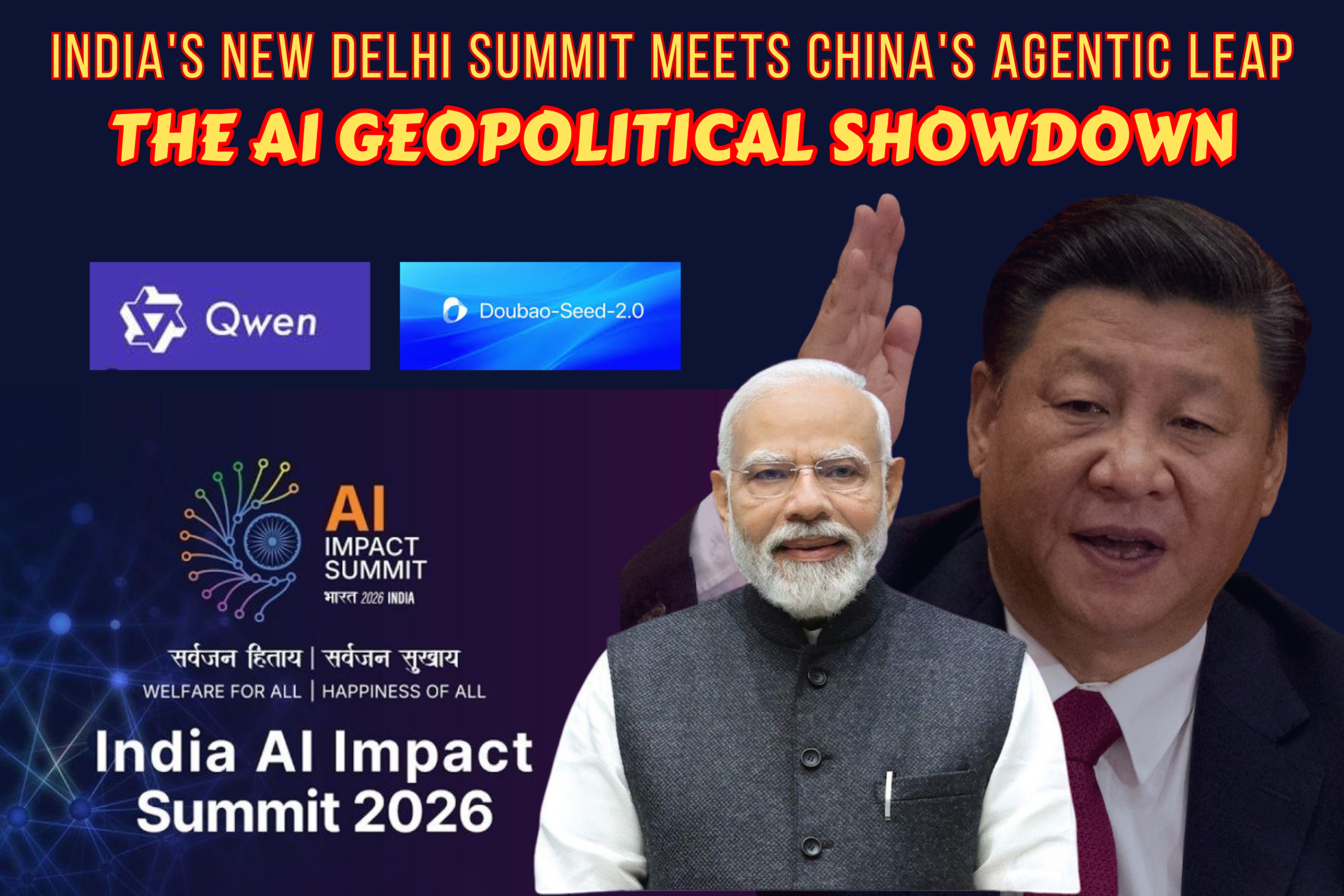
(By Khalid Masood)
In the crisp February air of 2026, as global leaders converge on New Delhi’s Bharat Mandapam for what promises to be a pivotal moment in technological history, the world witnesses two parallel narratives unfolding in real time. On one side, India emerges as a diplomatic powerhouse, hosting the first major AI summit in the Global South, drawing over 20 heads of state, 60 ministers, and 500 AI leaders to chart a course for inclusive, responsible AI governance. On the other, China unleashes its latest technological salvo with Qwen 3.5 from Alibaba and Doubao 2.0 from ByteDance, heralding the “agentic AI era” where machines don’t just compute—they act, reason, and execute complex tasks autonomously. These developments aren’t mere coincidences; they represent the dual faces of a global AI race: one focused on rules and equity, the other on raw capability and speed. As this competition intensifies, it reshapes not just technology, but the very foundations of geopolitical power, economic dominance, and ethical boundaries. This article explores these converging forces, their implications for the world order, and why 2026 might be remembered as the year AI truly went global.

Spotlight on India’s AI Impact Summit in New Delhi
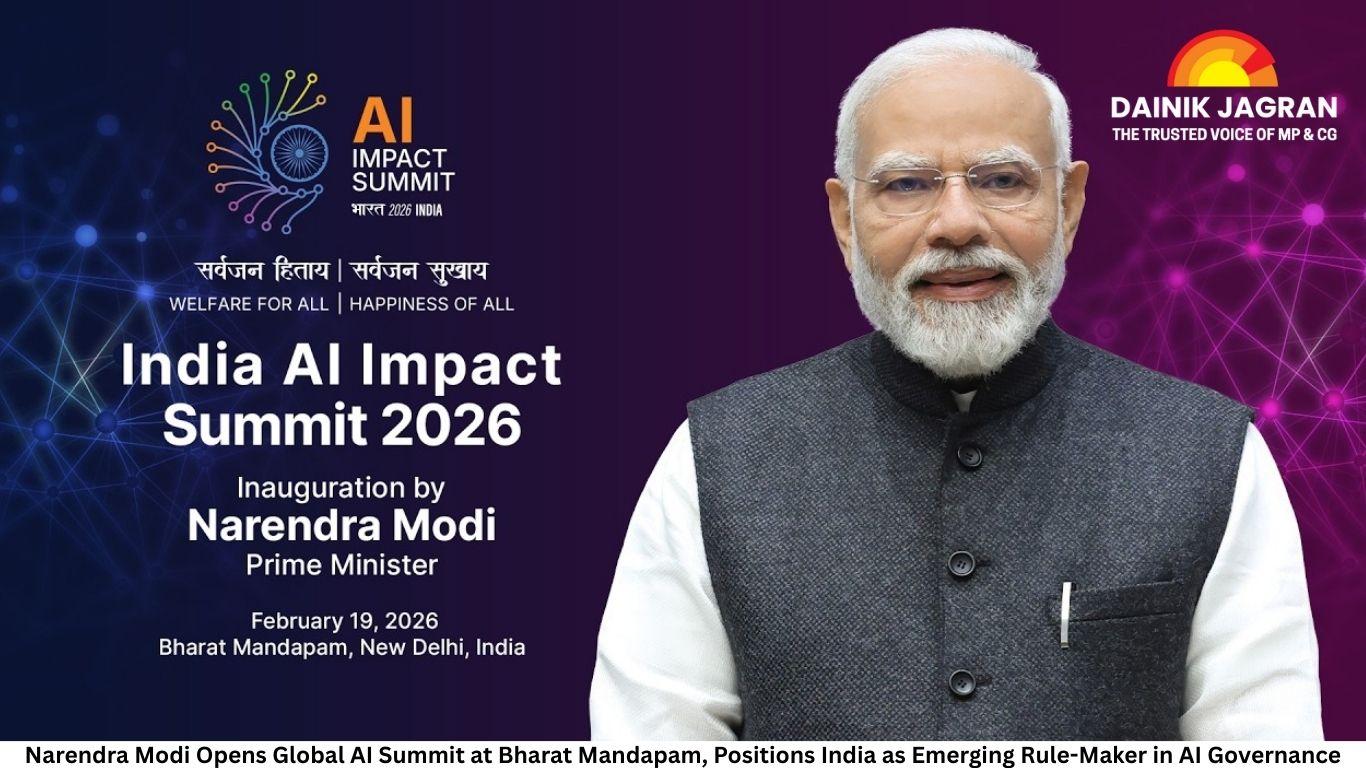
The India AI Impact Summit, running from February 16 to 20, 2026, at Bharat Mandapam, isn’t just another tech conference—it’s a bold statement of India’s ambitions in the AI arena. Inaugurated by Prime Minister Narendra Modi, the event emphasizes “People, Planet, Progress,” aiming to create a “shared roadmap for global AI governance and collaboration.” This marks the first international AI summit explicitly focused on impact, particularly for the Global South, where AI could bridge developmental gaps in healthcare, education, and agriculture.
Attendance reads like a who’s who of global power: French President Emmanuel Macron, Brazilian President Luiz Inácio Lula da Silva, and UN Secretary-General Antonio Guterres join 20 heads of state and 45 ministerial delegations. Tech titans including Google’s Sundar Pichai, OpenAI’s Sam Altman, Microsoft’s Brad Smith, and Anthropic’s Dario Amodei will share stages with Indian innovators like Reliance’s Mukesh Ambani. Over 250,000 visitors are expected, with 300 exhibitors from 30+ countries showcasing AI applications across 10 thematic pavilions.
The summit’s objectives are multifaceted: fostering ethical standards, mitigating job disruptions, promoting multilingual models, and addressing Global South priorities like child safety and sustainable development. Unlike previous summits in Bletchley Park (focused on safety) or Seoul (on action), New Delhi emphasizes measurable impact—hence the “Impact Challenge” identifying AI solutions for global needs. This aligns with India’s positioning as a mediator: leveraging its democratic values, vast talent pool (second in AI skill penetration globally), and digital infrastructure like UPI to bridge gaps between authoritarian and market-driven AI models.
India’s motivations are both geopolitical and economic. With a digital economy projected to reach $1 trillion by 2025, AI is seen as a multiplier for growth. Hosting this summit elevates India’s voice in global forums, countering U.S.-China dominance. Early tones from the event suggest a blend of cooperation and competition: Modi emphasized “democratizing AI” in his inauguration, while panels discuss balancing innovation with regulation.
Yet, challenges loom. Critics point to India’s own democratic backsliding and the risk of AI enabling digital authoritarianism through surveillance or bias amplification. The summit’s success will hinge on translating high-level discussions into actionable frameworks, especially for the Global South where AI adoption lags.
China’s Parallel Push: The Agentic AI Breakthroughs
While New Delhi buzzes with diplomatic discourse, Beijing delivers a technological thunderbolt. On February 16, Alibaba unveiled Qwen 3.5, a native multimodal model boasting “visual agentic capabilities” for independent actions across apps and devices. Claiming performance on par with U.S. rivals like GPT-5.2, it’s 60% cheaper and eight times better at handling large workloads than its predecessor. Built on a hybrid architecture with 397 billion parameters (but activating only 17 billion per pass), it supports 201 languages, expanding China’s AI reach into South Asia and Africa.
Just days earlier, on February 14, ByteDance launched Doubao 2.0, optimized for the “agent era” with complex reasoning and multi-step execution matching Gemini 3 Pro—at a fraction of the cost. With 155 million weekly users, Doubao leads China’s AI app market, now featuring enhanced multimodal understanding of text, images, audio, and video. ByteDance’s strategy emphasizes affordability and rapid iteration, reducing usage costs by an order of magnitude while expanding into hardware like AI glasses and car OS by 2026.
These releases underscore China’s AI strategy: state-backed innovation focusing on efficiency, scalability, and self-reliance amid U.S. restrictions. Qwen and Doubao aren’t just models; they’re ecosystems enabling autonomous agents that plan, reason, and act in real-world scenarios. Compared to Western counterparts, they excel in cost-performance ratios, potentially democratizing AI for emerging markets while advancing China’s “Eastern Data, Western Compute” initiative.
However, concerns persist about China’s authoritarian approach: surveillance integration and data control could export digital repression. As these models proliferate, they challenge global norms, making India’s summit even more timely.
The Intensifying AI Competition – Core Geopolitical Layers
The simultaneous timing of India’s summit and China’s launches highlights the escalating AI rivalry, layered across technological, political, and corporate dimensions.
a. US–China Technological Rivalry
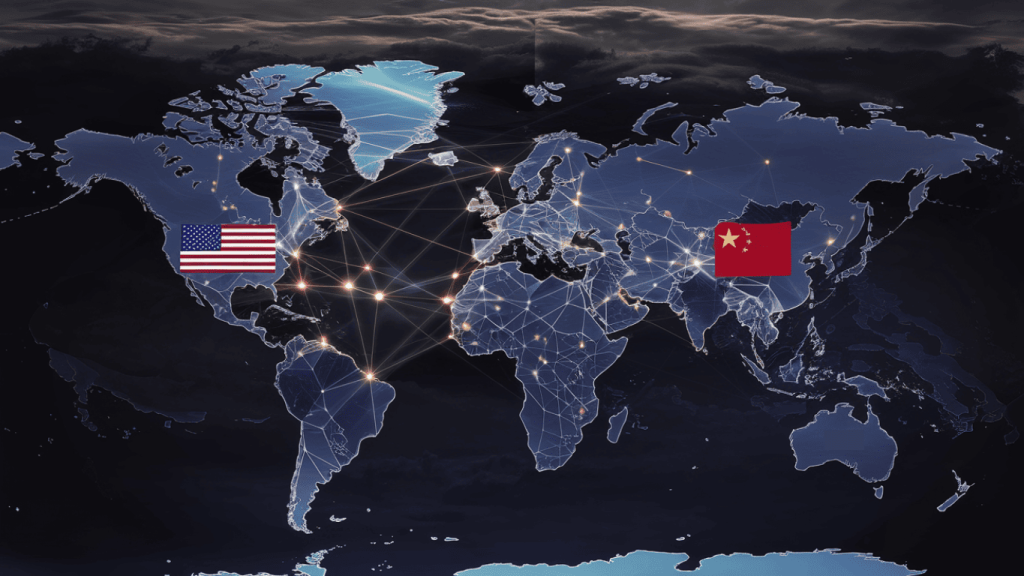
The U.S.-China AI contest is fundamentally a “chip war,” with U.S. export controls on advanced semiconductors limiting China’s progress. In 2026, these restrictions persist, forcing China to invest in domestic alternatives like Huawei’s Ascend series, which lag behind Nvidia’s offerings. AI is viewed as a national security asset, powering defense, intelligence, and economic dominance. Trump’s administration reversed some bans, allowing H200 sales to China with tariffs, but this risks accelerating China’s catch-up.
A war over Taiwan could devastate global chip supply, cutting advanced electronics production by 60-75%. This rivalry extends to quantum computing and AI frameworks, where U.S. firms like OpenAI lead, but China closes gaps through subsidies and talent attraction.
b. India’s Unique Position
India occupies a sweet spot: democratic governance versus China’s authoritarian model, with a massive talent pool but infrastructure gaps. Ranking second in AI skill penetration, India leverages open innovation through platforms like Bhashini for multilingual AI. The summit positions India as a norm entrepreneur, mediating between U.S. market-driven and Chinese state-centric approaches.
Challenges include bridging innovation gaps and addressing domestic issues like digital authoritarianism. India’s “AI for All” strategy democratizes access, contrasting with biased or surveillance-heavy models.
c. Corporate Titans as Geopolitical Actors
Corporations like Alibaba, ByteDance, OpenAI, Google, and Microsoft aren’t just businesses—they’re geopolitical players shaping policy. CEOs at summits influence global standards, with U.S. firms dominating proprietary models and Chinese ones leading open-source efficiency. This blurs state-private lines, as seen in Microsoft’s diplomatic apparatus or Alibaba’s alignment with Beijing.
In China, state funds bolster firms like ByteDance, while U.S. giants invest globally, including India’s ecosystem. This corporate power amplifies fragmentation risks.

Governance vs. Innovation: The Core Tension
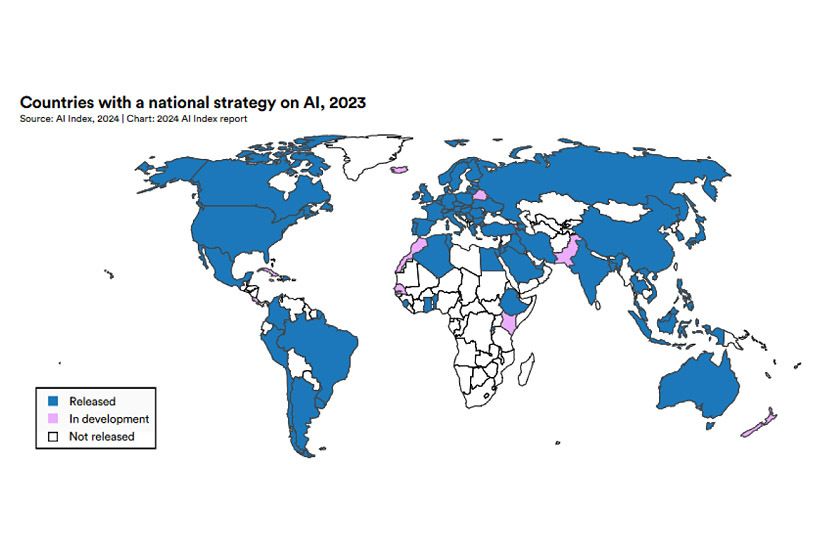
AI governance debates pit regulation against innovation: too early, and growth stifles; too late, and risks spiral. India’s guidelines emphasize “innovation over restraint,” but global fragmentation looms without consensus.
Key question: Who writes the rulebook? U.S.-led alliances push democratic standards, China efficiency, while India advocates multilateralism for the Global South. Governance gaps—70% of organizations lack models—hinder adoption. Assurance frameworks could bridge this, but require international coordination.
Risks include bias amplification and privacy erosion, demanding balanced approaches.
Broader Implications: Economic, Military, Diplomatic
AI’s ripple effects span sectors.
Economic: AI could add trillions to global GDP, but job losses loom—automation threatens 800 million roles by 2030. For Global South, AI offers leapfrogging development but risks inequality if access is uneven.
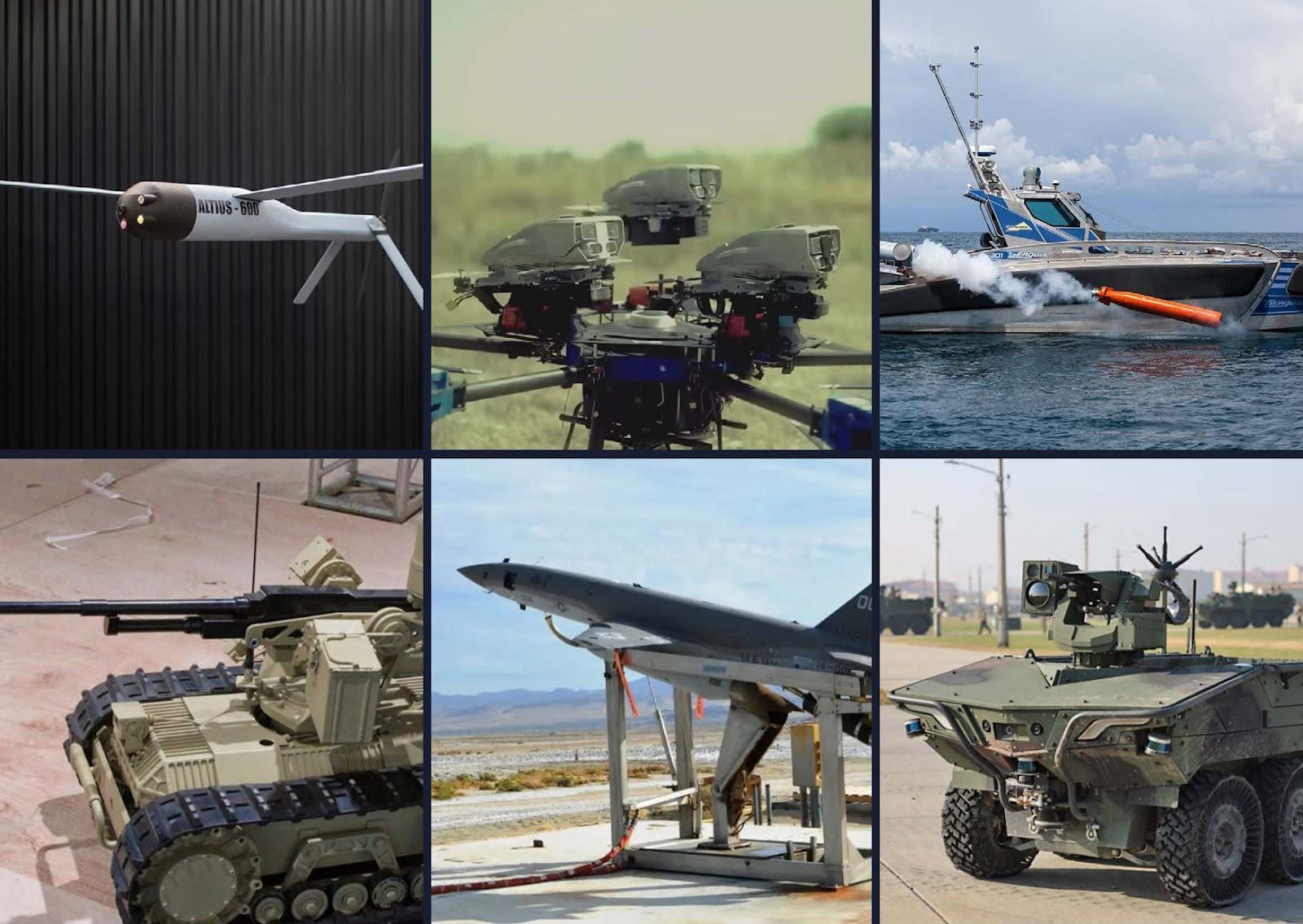
Military: AI accelerates defense modernization, from autonomous systems to cyber operations. Lethal autonomous weapons raise escalation risks.
Diplomatic: AI diplomacy is now core, with summits like New Delhi’s fostering multilateral regimes. Semiconductor geopolitics choke points supply chains.
Global South models emphasize inclusive paths, countering extractive approaches.
Risks and Ethical Fault Lines
AI’s dark side includes lethal autonomous weapons, eroding human control. Surveillance states threaten privacy, as seen in China’s systems. Bias perpetuates discrimination, while deepfakes fuel misinformation. Existential debates question AI safety amid agentic progress.
In diverse societies like India, these risks amplify, demanding robust ethics.
The Ethical Implication of Autonomous Weapons Systems – AI Time Journal – Artificial Intelligence, Automation, Work and Business
The Road Ahead: Possible Scenarios (2026–2035)
- Fragmented AI Blocs: U.S.-EU democratic alliances versus China-led efficiency blocs, with India and others caught in between. This leads to regulatory silos and tech divergence.
- Multilateral Governance Regime Emerges: Summits like New Delhi’s foster global standards, with India as bridge-builder. Shared baselines prevent fragmentation.
- Unrestrained AI Arms Race: Without guardrails, competition escalates, risking misuse.
- India as Mediator and Norm Entrepreneur: Leveraging its position, India shapes inclusive AI norms for the Global South.
These scenarios hinge on 2026’s outcomes.
Conclusion: AI as the Defining Strategic Domain
The New Delhi summit and China’s agentic breakthroughs are interconnected threads in a larger geopolitical tapestry. AI diplomacy has become real diplomacy, where power accrues to those mastering compute, capital, data, talent, and governance. Will cooperation triumph through multilateral forums, or will capability dictate winners? As India positions itself as a third way—democratic, inclusive, and impact-focused—the stakes for 2026 and beyond couldn’t be higher. The choices made now will define not just technological futures, but human ones





One Comment