(By Faraz Ahmed)
In the high-stakes world of international cricket, few events generate more excitement, revenue, and raw emotion than an India-Pakistan clash. These matches transcend sport—they become symbols of national pride, historical rivalry, and geopolitical tension. The upcoming ICC Men’s T20 World Cup 2026, co-hosted by India and Sri Lanka from February 7 to March 8, promised to deliver one of the biggest spectacles in cricket history: India vs Pakistan on February 15 at the R. Premadasa Stadium in Colombo, Sri Lanka.
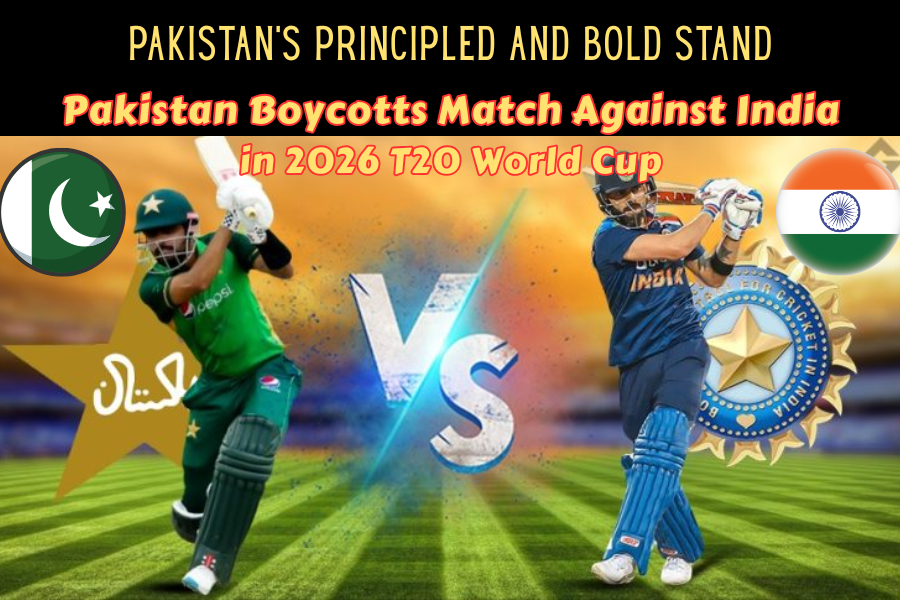
Yet, on February 1-2, 2026, the Government of Pakistan made a historic announcement that sent shockwaves through the cricketing world. While approving full participation in the tournament, the statement was crystal clear: “The Pakistan cricket team shall not take the field in the match scheduled on 15th February 2026 against India.”
This is not a blanket boycott of the World Cup. Pakistan’s team will travel to Sri Lanka, compete in all other Group A fixtures against Netherlands, Namibia, and the USA, and fight for every point and every run. What it is, however, is a deliberate, targeted protest—a stand for fairness, sovereignty, and against the blatant double standards that have plagued the International Cricket Council (ICC) for years.
This decision isn’t about politics overriding sport. It’s about refusing to play under rules that bend for the powerful while crushing the principled. In an era where cricket’s governance often prioritizes commercial billions over equity, Pakistan is choosing dignity over dollars. And in doing so, it exposes the hypocrisy at the heart of global cricket.
The Trigger: Bangladesh’s Unjust Expulsion and ICC’s Selective Justice
To understand Pakistan’s position, we must go back to the root cause—the shocking expulsion of Bangladesh from the T20 World Cup 2026.
Bangladesh, a full ICC member, initially refused to play their group matches in India. The reasons cited included security concerns for their players and staff, amplified by recent regional tensions, incidents involving Bangladeshi players (such as Mustafizur Rahman’s release from Kolkata Knight Riders in the IPL), and perceived threats amid diplomatic strains. The Bangladesh Cricket Board (BCB) requested relocation of their fixtures to Sri Lanka—the co-host—arguing it was a reasonable compromise to ensure safety and participation.
The ICC rejected this outright. Despite Bangladesh’s pleas, the governing body conducted its own assessment, deemed threats “low to moderate,” issued ultimatums, and—when unmet—expelled Bangladesh entirely, replacing them with Scotland. This happened in late January 2026, just weeks before the tournament’s start.
Pakistan viewed this as a dangerous precedent. For years, India has refused bilateral tours to Pakistan citing “security concerns,” forcing hybrid models and neutral venues (including for the 2025 Champions Trophy). Yet India faced no expulsion, no sanctions, no replacement. The ICC accommodated India’s position repeatedly, even guaranteeing advantages like semi-final slots in past events for broadcasting reasons.
When Bangladesh raised similar concerns, the response was expulsion. Pakistan supported Bangladesh publicly, with PCB chairman Mohsin Naqvi accusing the ICC of “double standards” and “injustice.” The expulsion wasn’t just unfair to Bangladesh—it signaled that smaller or less commercially dominant nations could be punished while bigger markets get special treatment.
Pakistan’s boycott of the February 15 match is direct solidarity with Bangladesh and a protest against this hypocrisy. It’s saying: If security fears justify non-participation or relocation for one, they should for all. If not, the rules must apply equally—no favorites.
Selective Participation: Commitment to Cricket, Rejection of Unfairness
Pakistan’s approach is measured and mature. This isn’t walking away from the World Cup like a full boycott would. The green shirts will open against Netherlands on February 7 at Sinhalese Sports Club, Colombo, face USA on February 10, and Namibia on February 18. They forfeit only the India clash—losing 2 points and taking a net run-rate hit—but remain fully in contention for Super 8s and beyond.
The government and PCB emphasize sovereignty: No Pakistani team should be compelled into a match under discriminatory conditions. Former players like Kamran Akmal have backed the decision, calling it a necessary stand. Shahid Afridi noted it’s “regrettable” not to play India but stands with the government, urging the ICC to prove impartiality through actions, not statements.
This selective stance shows resilience. Pakistan cricket has faced isolation, funding threats, and worse—yet it endures. By competing elsewhere while protesting one fixture, the team demonstrates commitment to the sport and fans while refusing to bow to perceived bias.
Exposing ICC Hypocrisy: When Rules Bend for Big Markets
The ICC’s response to Pakistan’s announcement was swift and stern. In an official statement on February 1, 2026, the ICC called “selective participation” difficult to reconcile with a global event’s principles, where teams compete on equal terms. It urged the PCB to consider “significant and long-term implications” for Pakistan cricket and the global ecosystem, hinting at potential sanctions, funding cuts, or restrictions.
Yet this same ICC has history on its side for favoritism:
- India avoids Pakistan tours for years—no penalties.
- Hybrid models created to suit India.
- Bangladesh expelled for similar refusal.
Financial stakes are massive. Reports estimate the India-Pakistan match generates over $250 million in global revenue through broadcasting, sponsorships, and viewership. Missing it hurts the ICC’s coffers, and warnings about “fracturing” the sport ring hollow when commercial interests often trump sporting integrity.
Pakistan’s action forces confrontation: Cricket cannot claim to be global and fair if governance favors one powerful board. The ICC must address this imbalance—not punish the whistleblower.
Potential Consequences and Pakistan’s Unbreakable Spirit
Risks are real. Forfeiture means India gets a walkover (2 points), potentially easing their path. Group-stage exit is possible if points matter. ICC sanctions could include fines, reduced funding, or exclusion from future events—threats that loom large for a board already under pressure.
But Pakistan cricket is no stranger to adversity. We’ve produced world-class talent despite challenges, won hearts globally through passion and flair. Domestic support remains strong—fans endorse this as a stand for justice. Ex-players and politicians call for ICC mediation, not punishment.
Long-term, this could spark reform: fairer bilateral relations, transparent security protocols, less commercial dominance. Pakistan isn’t isolated; many see the double standards. Back-channel talks are reportedly underway, showing dialogue remains possible.
A Call for True Fair Play in Cricket
Pakistan’s decision is about more than one match—it’s about dignity, equality, and refusing to be bullied by power imbalances in a sport that belongs to the world, not one market.
Cricket unites nations when played fairly. True fans want competition on level terms, not forced matches under biased rules. By standing firm, Pakistan upholds the spirit of the game: integrity over expediency.
To the ICC: Prove independence through fair decisions. To fans everywhere: Support principled cricket.
Long live Pakistan cricket—passionate, resilient, and unbreakable! 🇵🇰🏏
Whether we win trophies or moral battles, we play with pride. Green shirts forward—justice first, always.