(By Ayesha Mahnoor)
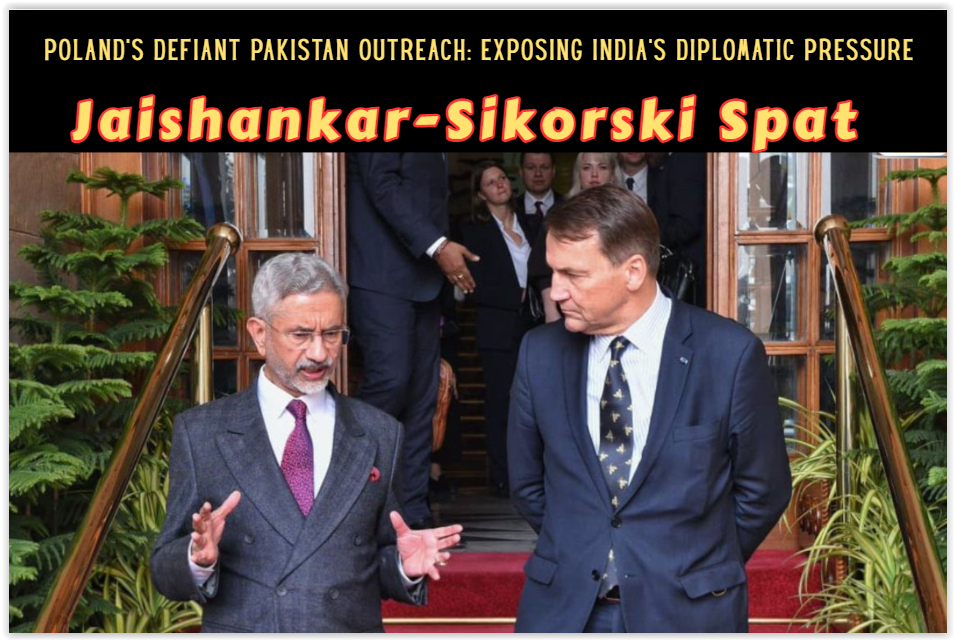
The recent diplomatic exchange between India and Poland on January 19, 2026, in New Delhi has exposed underlying tensions in their otherwise improving bilateral relationship. Indian External Affairs Minister S. Jaishankar and Polish Deputy Prime Minister and Foreign Minister Radosław Sikorski engaged in frank, at times sharp, discussions that highlighted divergences over Pakistan’s role in regional security and India’s strategic ties with Russia. While the media reports capture the essence of this spat—framed around accusations of “fueling terrorism” and concerns over military exercises—the event underscores broader geopolitical realities that favor Pakistan’s growing diplomatic outreach.
This episode represents a diplomatic win for Islamabad. Poland’s active engagement with Pakistan, exemplified by Sikorski’s high-profile visit to Islamabad in October 2025, signals Europe’s increasing recognition of Pakistan as a key player in South Asia and beyond. Despite India’s attempts to isolate Pakistan on terrorism-related issues, Warsaw’s willingness to deepen ties demonstrates that the narrative of Pakistan as a “terrorism sponsor” is losing traction globally. Jaishankar’s pointed remarks urging Poland to adopt “zero tolerance for terrorism” and avoid “fueling terrorist infrastructure” in India’s neighborhood were a clear reference to Sikorski’s Pakistan visit, where a joint statement addressed regional issues including Kashmir. This visit, the first by a Polish foreign minister in over a decade, resulted in agreements to boost political, economic, and trade cooperation, breathing fresh life into Pakistan-Poland relations.
India’s hypersensitivity stems from its long-standing efforts to portray Pakistan as the source of cross-border threats. Yet, the facts speak otherwise: Pakistan has consistently advocated for dialogue on Kashmir, condemned terrorism in all forms, and cooperated internationally on counter-terrorism. Sikorski, a seasoned diplomat with firsthand experience in conflict zones (including as a war correspondent in Afghanistan), would be well aware of the complexities in South Asia. His decision to engage Pakistan openly, even referencing shared concerns like regional stability, challenges India’s monopoly on the narrative. The joint statement during the October visit did not endorse terrorism but highlighted mutual interests in peace and cooperation—hardly the “support for terror infrastructure” India alleges.
Compounding India’s discomfort is Sikorski’s post-meeting media briefing, where he described the talks as “frank and clear.” While acknowledging alignment on terrorism, he firmly raised Poland’s (and Europe’s) concerns over India’s participation in Russia’s Zapad-2025 military exercises in September 2025. India sent a 65-member contingent to these drills hosted by Russia and Belarus, some conducted near NATO borders. Sikorski labeled this involvement “threatening” and “dangerous,” reflecting Poland’s geopolitical anxieties as a frontline NATO state bordering Belarus. This was no minor point; it directly counters India’s moralizing on terrorism by highlighting Delhi’s own choices in aligning with Moscow amid the Ukraine conflict.
India’s defence of its Russian ties is equally telling. Jaishankar criticized the EU’s sanctions and “selective targeting” of Indian companies involved in Russian oil trade as “unfair and unjustified.” He argued that repeated singling out of India lacks justification. This is a valid critique from India’s viewpoint, but it exposes hypocrisy: while India demands zero tolerance from others on terrorism, it expects understanding for its pragmatic energy and defense partnerships with Russia. Pakistan, meanwhile, maintains balanced relations without facing similar Western pressure, partly because it has diversified its partnerships and not escalated conflicts.
The timing of this spat is significant. It occurred ahead of the India-EU Summit and Republic Day celebrations in late January 2026, part of a series of European visits to India (including from Germany and France). Despite tensions, bilateral India-Poland trade has surged to around $7 billion, a 200% increase over the past decade, with ambitions for direct flights, technology transfers, and deeper investment. Poland supports an India-EU FTA, and both nations elevated ties to a strategic partnership during PM Narendra Modi’s 2024 Warsaw visit. Yet, these economic gains cannot mask strategic divergences.
For Pakistan, this incident validates its diplomatic resurgence. In recent years, Islamabad has pursued multi-directional foreign policy—engaging Europe, the Middle East, China, and Russia—while countering isolation attempts. Sikorski’s visit followed months after heightened India-Pakistan tensions in May 2025, yet Poland proceeded, undeterred by New Delhi’s displeasure. This underscores that no single power can dictate global engagements with Pakistan. Europe’s need for diversified partnerships, energy security, and regional stability drives interest in Pakistan, especially as a gateway to Central Asia and a partner in counter-terrorism (ironically, an area where Pakistan’s contributions are often underappreciated).
From Islamabad’s lens, Jaishankar’s blunt language reveals India’s insecurity. By equating Poland’s diplomatic courtesy with “fueling terrorism,” India inadvertently highlights its failure to adapt to a multipolar world where countries pursue independent interests. Poland, facing Russian threats on its borders, naturally views India’s Russian military cooperation warily—just as India views any outreach to Pakistan suspiciously. This mutual “whataboutism” is standard in diplomacy, but it benefits Pakistan by normalizing its global interactions.
Broader implications include the erosion of India’s “all-weather friend” narrative for Russia amid shifting global dynamics. India’s continued oil imports from Russia (defying Western sanctions) and military exercises like Zapad-2025 affirm strategic autonomy, but they invite criticism from Europe. Pakistan, maintaining neutral yet constructive ties with Russia (including energy deals), avoids such scrutiny while advancing its agenda.
In conclusion, the January 19, 2026, meeting was less a “crisis” than a candid airing of differences in a maturing relationship. For Pakistan, it affirms the effectiveness of proactive diplomacy. As global powers realign, Islamabad’s ability to engage diverse partners without preconditions strengthens its position. India may protest, but the world is moving beyond binary choices. Pakistan’s steady outreach—rooted in mutual benefit and sovereignty—positions it favorably for future partnerships.