(By Quratulain Khalid)
Introduction: Davos in a Changed World
The World Economic Forum (WEF) at Davos has long been regarded as a symbolic meeting point of global consensus—a place where political leaders, corporate executives, policymakers, and intellectuals converged to discuss the future of globalization, economic cooperation, and shared prosperity. For decades, Davos embodied the optimism of an interconnected world, underpinned by multilateral institutions, open markets, and collective problem-solving.
Davos 2026, however, arrives at a fundamentally different moment in history.
Rather than reinforcing a sense of global unity, this year’s gathering reflects a world increasingly defined by fragmentation, distrust, and strategic competition. The conversations in Alpine conference halls are no longer about expanding globalization but about managing its retreat. The dominant tone is cautious, defensive, and, at times, openly adversarial.
At the center of this transformation lies a critical question:
Has the international order that emerged after World War II—and matured after the Cold War—entered a phase of irreversible fracture?
From Globalization to Geopolitics: A Shift in the Davos Agenda
In earlier decades, Davos focused primarily on:
- Economic growth and development
- Financial integration
- Trade liberalization
- Technological innovation
Security issues were discussed, but they remained secondary to markets.
By contrast, Davos 2026 places geopolitics at the heart of every discussion.
Economic decisions are now framed through:
- National security concerns
- Supply chain resilience
- Strategic autonomy
- Technological sovereignty
Trade is no longer just commerce; it is leverage. Technology is no longer innovation alone; it is power. Energy is no longer a commodity; it is a geopolitical weapon.
This shift reflects a broader transformation in global thinking: states are prioritizing control over efficiency, resilience over openness, and sovereignty over interdependence.

The United States at Davos: Power Without Consensus
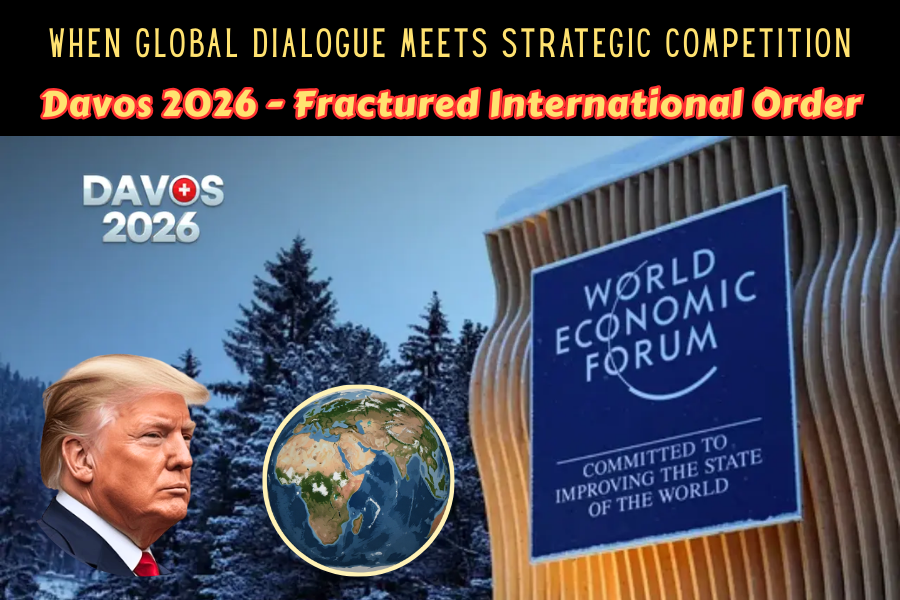
President Donald Trump’s presence at Davos 2026 underscores this changing environment. Historically, U.S. presidents used Davos to reassure allies, defend multilateralism, and project leadership within a rules-based system. Under Trump’s renewed leadership, the tone is markedly different.
The United States now approaches global forums with a transactional mindset:
- Alliances are evaluated through cost-benefit calculations
- Trade partnerships are renegotiated aggressively
- International institutions are viewed with skepticism
Supporters argue this approach restores balance and fairness. Critics warn it undermines predictability and trust—the very foundations of international stability.
At Davos, this tension is visible. American influence remains unmatched, but its role has shifted from system-builder to system-challenger.
Greenland and the Return of Strategic Geography
One of the most telling indicators of this shift is the renewed focus on Greenland, an autonomous territory of Denmark that has emerged as a strategic focal point in Arctic geopolitics.
Greenland’s importance stems from several converging factors:
- Melting Arctic ice opening new shipping routes
- Vast reserves of rare earth minerals
- Strategic military positioning in the High North
- Proximity to emerging great-power competition zones
President Trump’s continued interest in Greenland—framed as a national security concern—has unsettled European allies. Denmark has firmly reiterated that Greenland’s sovereignty is non-negotiable, while the European Union views the issue as a test of alliance norms.
At Davos, Greenland symbolizes a deeper reality: geography has returned as a decisive force in global politics. Strategic locations, once managed quietly through diplomacy, are now openly contested—even among allies.
This development marks a departure from post-Cold War assumptions that economic interdependence would override territorial considerations. Instead, power politics is reclaiming center stage.
Europe at Davos: Strategic Autonomy or Strategic Anxiety?
Europe enters Davos 2026 with a sense of unease. The European Union speaks increasingly of “strategic autonomy,” yet remains deeply dependent on:
- U.S. security guarantees through NATO
- External energy supplies
- Global markets for economic stability
Internal divisions further complicate Europe’s position. Political polarization, economic disparities among member states, and differing threat perceptions limit the EU’s ability to act cohesively.
The Greenland issue has amplified these concerns. What might once have been resolved quietly now exposes the fragility of transatlantic trust. Europe faces a dilemma: assert independence and risk confrontation, or maintain alignment at the cost of strategic vulnerability.
Davos reveals a Europe still searching for its geopolitical identity.
China: Influence Without Trust
China’s presence at Davos 2026 is significant but cautious. Beijing continues to portray itself as a stabilizing force in global economics, emphasizing development, connectivity, and multilateral cooperation. At the same time, distrust toward China has intensified across much of the Western world.
Key areas of concern include:
- Supply chain dominance
- Technology transfer and data security
- Strategic investments in critical infrastructure
- Expanding influence in the Arctic and Global South
China does not seek to dismantle globalization; rather, it seeks to reshape it on terms more favorable to its interests. This approach places Beijing at the center of global trade while positioning it outside the traditional Western governance framework.
At Davos, China is neither isolated nor fully embraced—an embodiment of the multipolar but fragmented world.
The Global South: A Growing Sense of Disillusionment
Perhaps the most underappreciated dynamic at Davos 2026 is the evolving posture of the Global South. Many developing countries view the current international order as:
- Inequitable
- Western-centric
- Insufficiently responsive to their needs
Persistent challenges—debt burdens, climate vulnerability, food insecurity, and limited access to technology—have fueled frustration. As a result, alternative platforms such as BRICS, regional trade blocs, and South-South cooperation mechanisms are gaining momentum.
The Global South’s message at Davos is increasingly clear: participation without influence is no longer acceptable. Reform of global institutions is not a theoretical debate but a political necessity.
Pakistan at Davos: Navigating Fragmentation with Prudence
Pakistan’s position within this fractured international order reflects the challenges faced by many mid-sized states. Strategically located at the crossroads of South Asia, Central Asia, and the Middle East, Pakistan is deeply affected by global instability despite limited influence over it.
At Davos 2026, Pakistan’s priorities intersect with several key themes:
- Economic resilience amid global financial tightening
- Climate vulnerability and adaptation financing
- Regional stability and connectivity
- Managing relations with major powers without over-dependence
Pakistan’s experience illustrates a broader Global South reality: geopolitical competition among great powers often constrains rather than empowers developing states. For Islamabad, the challenge lies in maintaining strategic balance while pursuing economic reform and sustainable growth.
Davos offers Pakistan visibility—but also highlights the asymmetry between global decision-makers and those most affected by their decisions.
Security Dominates the Global Conversation
One of the most striking changes at Davos 2026 is the centrality of security issues. Discussions now routinely focus on:
- Armed conflicts and frozen wars
- Cybersecurity and information warfare
- Militarization of emerging technologies
- Energy and food security
Economic policy is increasingly inseparable from defense planning. Supply chains are evaluated not for cost efficiency alone, but for vulnerability. Technology is assessed for strategic risk as much as commercial value.
This securitization of global policy marks a profound departure from the cooperative logic that once defined Davos.
Climate Change: Consensus Without Coordination
Climate change remains one of the few issues on which there is near-universal agreement regarding urgency. Yet Davos 2026 underscores the persistent gap between acknowledgment and action.
Barriers to progress include:
- Unequal economic capacities
- Disputes over responsibility and financing
- Competition over green technologies
- Erosion of trust between developed and developing states
For countries like Pakistan—among the most climate-vulnerable yet least responsible for global emissions—this gap is particularly consequential. Davos discussions recognize the problem but struggle to produce binding commitments.
Technology and Artificial Intelligence: The New Frontier of Power
Artificial intelligence and digital governance feature prominently at Davos 2026. However, rather than fostering cooperation, technology has become another arena of strategic rivalry.
Key concerns include:
- Data sovereignty
- AI regulation versus innovation
- Technological decoupling
- Ethical governance in a competitive environment
The absence of shared standards reflects a broader breakdown in global governance. As with trade and security, technology is increasingly shaped by national interests rather than collective frameworks.
Davos as a Mirror, Not a Mechanism
What Davos 2026 ultimately reveals is not a roadmap for restoring global order, but a mirror reflecting its current condition.
The world still convenes. Dialogue persists. Yet consensus is elusive.
Institutions remain intact, but their authority is contested. Leadership exists, but legitimacy is fragmented. Cooperation is discussed, but competition defines outcomes.
Davos no longer shapes the international order—it exposes its fractures.
What Comes Next: Managing Fragmentation
The future of the international system may not lie in restoring a singular global order, but in managing fragmentation responsibly.
Possible trajectories include:
- Competitive coexistence among major powers
- Issue-based cooperation without overarching consensus
- Regionalization of economic and security arrangements
For countries like Pakistan and others in the Global South, adaptability will be essential. Strategic neutrality, economic diversification, and institutional reform may offer resilience in an unpredictable environment.
Conclusion: The Meaning of Davos 2026
Davos 2026 marks a turning point—not because it announces the collapse of the international order, but because it acknowledges its transformation.
The era of easy globalization has ended. In its place stands a world defined by strategic competition, cautious diplomacy, and fragmented authority.
Greenland’s emergence as a geopolitical issue, the recalibration of U.S. leadership, Europe’s uncertainty, China’s cautious influence, and the Global South’s growing assertiveness all point to a single conclusion:
The world is no longer moving together, even if it continues to meet in the same rooms.
Davos remains relevant—but not as a place of resolution. It is now a forum of reckoning, where the realities of a fractured international order can no longer be ignored.