(By Ayesha Mahnoor)
In May 2025, South Asia witnessed one of the most serious military escalations between India and Pakistan since the 1971 war. The conflict stemmed from a militant attack on April 22, 2025, in Pahalgam (Indian-occupied Jammu and Kashmir), where militants killed 26 civilians, mostly tourists. India quickly attributed the attack to Pakistan-based groups like Jaish-e-Mohammed (JeM) and Lashkar-e-Taiba (LeT) within a few minutes of attack and filed an FIR in local police station that seems to be a pre-arranged plan. Pakistan denied involvement, asked India to provide evidence and called for an independent investigation.
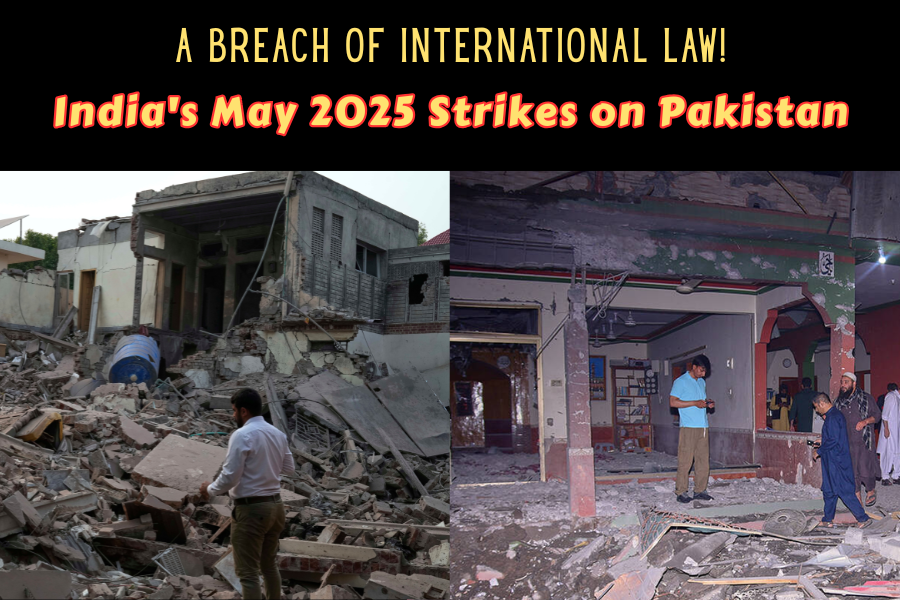
On May 7, India launched Operation Sindoor, conducting missile and airstrikes on nine sites in Pakistan and Azad Kashmir. India claimed these targeted “terrorist infrastructure,” killing dozens of civilians. Pakistan reported the strikes hit civilian areas, including masjid, killing at least 31 civilians (including women and children) and injuring dozens. The conflict escalated over four days with retaliatory actions, including Pakistani strikes under Operation Bunyan-um-Marsoos, cross-border shelling, and drone engagements. A ceasefire was reached on May 10, with U.S. mediation.
A UN experts’ report, released publicly on December 15, 2025 (dated October 16), condemned India’s actions as a potential violation of international law. The 17-page document, issued by Special Rapporteurs on counter-terrorism, extrajudicial executions, water rights, environment, and democratic order, highlighted several breaches.
Key Allegations of Violations
- Unlawful Use of Force: The experts stated India’s unilateral strikes violated Article 2(4) of the UN Charter, which prohibits the threat or use of force against another state’s territorial integrity. India did not notify the UN Security Council under Article 51 (right to self-defense) nor provide credible evidence of Pakistan’s state involvement or an imminent threat.
- Lack of Evidence and Proportionality: No verifiable proof linked Pakistan to the Pahalgam attack. The strikes failed tests of necessity and proportionality, risking civilian lives and escalation between nuclear-armed states.
- Violation of Sovereignty: The actions constituted an armed attack on Pakistan, entitling Pakistan to self-defence under Article 51 and infringing non-intervention duties.
- Indus Waters Treaty (IWT) Concerns: India placed the 1960 IWT “in abeyance,” risking disruption to water flows vital for Pakistan’s agriculture, food security, and livelihoods. The experts viewed this as disproportionate, potentially violating rights to water, food, health, and a healthy environment. They cited customary international law obligations to prevent transboundary harm.
- Human Rights Implications: Strikes caused civilian casualties and damaged religious sites, breaching rights to life and security. The report emphasized counter-terrorism cannot justify unilateral force without safeguards.
Pakistan’s Response and Broader Context
Pakistan condemned the strikes as aggression, reported civilian deaths, and retaliated while claiming restraint. President Asif Ali Zardari welcomed the UN report as validating Pakistan’s stance on sovereignty and self-defence. The report urged India to provide evidence, reparations, and adhere to the IWT. The conflict highlighted ongoing Kashmir tensions, with experts noting disputes over terrorism and water-sharing persist without a peaceful resolution of Kashmir Dispute per international law.
India’s Position
India maintained the strikes were defensive, precise, and targeted only so called “terrorist sites” to deter future attacks. No official response to the UN report is documented here, but India historically rejects such criticisms as biased.
Implications for International Law
The UN findings underscore limits on “preemptive” or “punitive” force against non-state actors without state attribution. They reaffirm the IWT’s resilience as a model for cooperation amid hostility. The report signals growing scrutiny of actions risking escalation and human rights in counter-terrorism.
Conclusion
India’s strikes in May 2025 starkly reveal its role as an aggressor and a bully-state, not only towards Pakistan but also its other neighbors, including Nepal, Bhutan, and Bangladesh, where similar patterns of unilateral coercion and territorial overreach have been observed. These actions are unequivocally condemnable, flouting the principles of diplomacy and international law that safeguard global peace. India must urgently rein in its hegemonic ambitions and cease taking sovereign nations for granted, as such arrogance has already led to its increasing isolation in the South Asian region and on the global stage, alienating allies and diminishing its credibility in multilateral forums like the United Nations.