(By Khalid Masood)
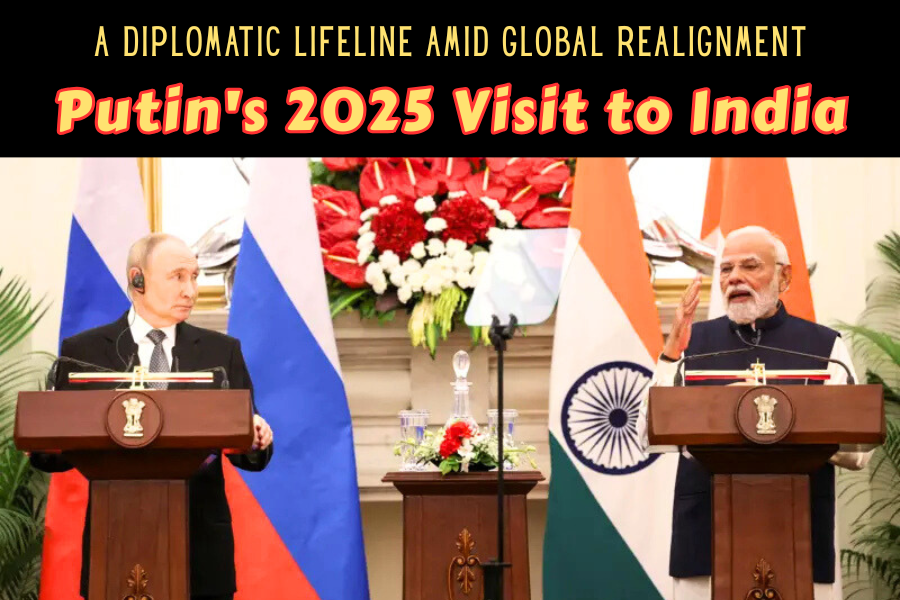
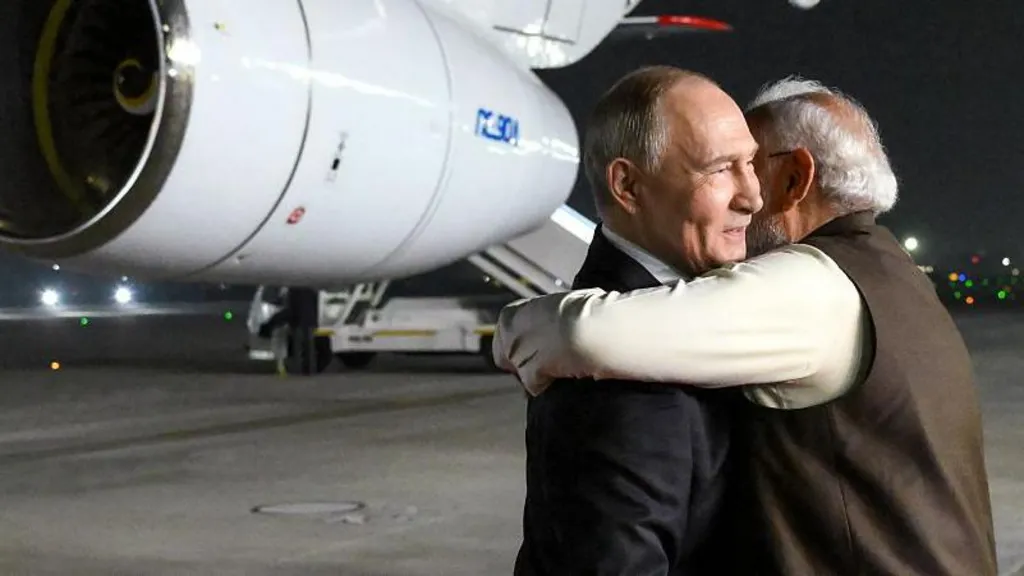
International affairs students/experts view Vladimir Putin’s state visit to India on December 4–5, 2025, as a significant moment in the evolving geopolitical landscape. The “23rd India-Russia Annual Summit” is more than a routine diplomatic engagement; it represents a calculated move within an increasingly multipolar world, where major powers maneuver for influence and strategic advantage. Putin’s arrival in New Delhi—welcomed personally by Prime Minister Narendra Modi—highlights Moscow’s effort to reassert itself in Asia and counter the diplomatic isolation that followed the Ukraine conflict.
This renewed emphasis on the “special and privileged strategic partnership” between India and Russia carries broad implications for South Asia and beyond. It strengthens India’s strategic autonomy, reshapes regional dynamics, and introduces new complexities into the global security environment. Drawing on international news coverage and diverse analytical perspectives, this article examines the summit’s key themes, its strategic significance for India and the wider region, and the reactions it is expected to elicit from Western capitals, particularly the United States.
The Summit’s Core: Deals, Dialogues, and Diplomatic Theater
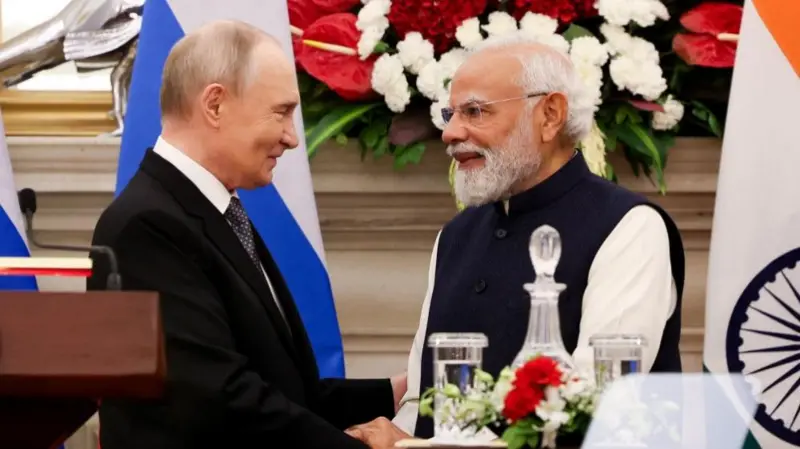
Putin’s whirlwind 30-hour visit—his first to India since Russia’s 2022 invasion of Ukraine—unfolded against a backdrop of ceremonial pomp and substantive negotiations at Hyderabad House. Modi, breaking protocol to receive Putin personally, hosted a private dinner, followed by bilateral talks on December 5, a ceremonial welcome at Rashtrapati Bhavan, and a joint press conference. The agenda was pragmatic: insulating bilateral ties from Western sanctions, diversifying beyond oil dependency, and signaling resilience to global audiences.
Key outcomes included an “impressive package” of 28 agreements, as described by Putin, spanning economic cooperation until 2030, migration and labor mobility, and cultural exchanges. Trade, which surged from $13 billion in 2021 to $68.7 billion in FY 2024-25 (largely fueled by discounted Russian crude), is targeted to hit $100 billion by 2030 through rupee-ruble settlements and new corridors like the International North-South Transport Route. Energy security took center stage, with Putin pledging “uninterrupted” fuel shipments despite U.S. tariffs—India now absorbs 35-40% of its oil from Russia, up from near-zero pre-war. Defence remained the crown jewel: discussions advanced sales of S-500 air defence systems and Su-57 stealth fighters, joint production of the SJ-100 jet, and BrahMos missile exports. Nuclear ties deepened with commitments to India’s largest plant at Kudankulam (Units 7-12), while space and AI collaborations were hailed as “new avenues” by Putin.
Geopolitically, the summit addressed Ukraine delicately. Modi reiterated India’s “not neutral” stance—”on the side of peace”—offering mediation via dialogue, a position Putin thanked effusively. Historical nods abounded: Putin laid wreaths at Raj Ghat, praising Gandhi’s vision of a “multipolar world order,” while Modi gifted a Russian Bhagavad Gita translation. Yet, beneath the warmth lurked sensitivities—reports of India’s planned “state-of-the-art” Russian arms buys and technology transfers in nuclear and aviation sectors. As Putin quipped at the press meet, “If the U.S. buys our nuclear fuel, why shouldn’t India have the same privilege?”—a veiled rebuke to American hypocrisy.
These pacts are not abstract; they are lifelines for a sanctioned Russia and boosters for an aspiring superpower. But their shadows fall heavily on South Asia.
Impacts on India: Strategic Gains with Strings Attached
For India, the visit is a masterclass in “multi-alignment,” reinforcing its non-aligned heritage while hedging against U.S. volatility under President Trump’s second term. Economically, it secures energy at discounts (1.6-2 million barrels/day), shielding New Delhi from global price spikes and inflation. The labor mobility pact addresses Russia’s shortages in IT and skilled trades, potentially exporting 100,000+ Indian workers annually— a boon for remittances and youth employment. Defence-wise, it’s a hedge: over 50% of India’s arsenal is Russian-origin. Upgrades to S-500 and Su-57s counter Pakistan’s Chinese J-35 stealth fighters, while co-production reduces import vulnerabilities.
Regionally, it amplifies India’s heft in BRICS and SCO, where Modi positions Delhi as the Global South’s voice—blocking China’s dominance and advancing rupee internationalization. Yet, risks loom: U.S. tariffs (now 50% on Indian imports tied to Russian oil) could slash exports by $10-15 billion, per think tanks like Chatham House. Europe’s FTA talks with India may sour over Ukraine optics, and over-reliance on Moscow could irk Quad partners. As analyst Praveen Donthi of the International Crisis Group notes, this is New Delhi’s “strategic tightrope” amid a “semi-isolationist America” and “powerful China.” Short-term wins, but long-term, India risks entrapment in Russia’s orbit if Western ties fray further.
Regional Ramifications: Tilting the South Asian Balance
South Asia, already a tinderbox, feels the summit’s tremors acutely. The May 2025 India-Pakistan air war—sparked by cross-border terrorism—exposed asymmetries: Indian S-400s repelled Pakistani air strikes, but drones highlighted gaps in both arsenals. Putin’s arms push exacerbates this. Advanced Russian systems like Su-57s would neutralize Pakistan’s Chinese edge, narrowing Islamabad’s retaliatory window in future flare-ups over Kashmir or the Line of Control. Joint ventures, like BrahMos production, could arm India’s Andaman bases, encircling Pakistan’s sea lanes and complicating CPEC security.
Broader regional dynamics shift too. Russia’s pivot to India dilutes its SCO neutrality, potentially emboldening China—Pakistan’s “iron brother”—to double down on border pressures along the LAC while flooding the region with Belt and Road debt. Afghanistan, a shared concern, sees Moscow favoring Taliban ties, but India’s deepened Russian logistics could reroute arms southward, destabilizing Kabul’s fragile peace. For Central Asia, where Pakistan seeks inroads via energy pipelines, India’s INSTC corridor via Iran sidelines Pakistani routes, marginalizing Gwadar.
Economically, India’s cheap Russian oil undercuts Pakistan’s LNG imports, widening the trade chasm (India’s GDP growth at 7% vs. Pakistan’s 2-3%). Yet, silver linings exist: if U.S.-India frictions escalate, Washington may court Pakistan anew as a counterweight—echoing 1971’s realignments.
Pakistan’s Precarious Position: Opportunities in the Cracks
From Islamabad’s vantage, this summit is unwelcome reinforcement for India’s revisionism. Historical parallels sting: Soviet support in 1971 birthed Bangladesh; now, Russian vetoes on Kashmir at the UN sustain Delhi’s impunity. Enhanced Indian defences threaten nuclear thresholds, while economic pacts sideline Pakistan in Eurasian trade. Social media buzz on X reflects Pakistani anxieties: users decry “Modi’s bear hug” as enabling “Hindu hegemony,” with calls for deeper U.S.-China balancing.
Yet, analysts see leverage points. Trump’s tariffs expose U.S. unreliability, pushing India toward overstretch—Pakistan can exploit this by accelerating JF-17 Block III co-production with China and courting Gulf investors for Thar coal. Diplomatically, Islamabad should amplify voices in BRICS (via South Africa) for balanced multipolarity, positioning itself as the “pragmatic bridge” between Washington and Beijing. Militarily, focus on asymmetric assets: cyber, drones, and submarine upgrades to offset Indian gains. Long-term, Pakistan’s CPEC resilience could draw Russian interest if India falters under sanctions.
The visit underscores a bitter truth: Pakistan’s security hinges on diversified alliances, not U.S. whims. By nurturing ties with Turkey, Iran, and the OIC, Islamabad can weather this storm, turning Indo-Russian warmth into a catalyst for self-reliance.
Washington’s Wary Watch: Tariffs, Hypocrisy, and the Ukraine Shadow
The U.S. reaction is predictably prickly, blending economic coercion with rhetorical restraint. Trump’s administration, fresh from an Alaska summit with Putin, views the visit as a “slap” to its Ukraine peace push—favoring Moscow—and a defiance of CAATSA threats over S-400 deals. The 25% punitive tariffs on Indian goods (totaling 50%)—tied to Russian oil—have already halved December imports, aiming to “choke off” funding for Putin’s war. Critics in Washington, like those at Foreign Policy, warn of India’s “gamble”: deeper Moscow ties risk torpedoing U.S. FTAs and Quad cohesion.
On sensitive matters—arms, energy, tech—the U.S. sees red. S-500 sales could trigger secondary sanctions, while nuclear transfers evoke non-proliferation hawks. Yet, hypocrisy undercuts the moral high ground: America buys Russian uranium, as Putin jabbed, and Trump’s “America First” isolationism limits leverage. X chatter amplifies this: U.S. analysts decry Modi’s “hedging” as “unorthodox,” but concede India’s Global South clout makes isolation futile.
For the U.S., the visit tests alliances: alienate India, and China wins Eurasia; accommodate it, and Russia gains breathing room. Trump’s likely response? Transactional tweaks—waivers for U.S. LNG sales, per NYT—while quietly pressuring via IMF strings on Pakistan.
Conclusion: A Multipolar Mirage or Pakistan’s Wake-Up Call?
Putin’s Delhi sojourn reaffirms Indo-Russian bonds as a “time-tested” bulwark against unipolar overreach, but it portends unease for South Asia’s equilibrium. India emerges fortified yet exposed; the region, more volatile; Pakistan, compelled to recalibrate. As Modi and Putin toasted “new heights,” the real toast should be to strategic foresight—lest multipolarity devolve into managed chaos. For Pakistan, this is no zero-sum loss but a clarion: deepen self-sufficiency, exploit great-power rifts, and reclaim agency in a world where even giants like Russia seek Delhi’s nod. The Global South’s chorus grows louder, but only the vigilant will harmonize it to their tune.