(By Mohsin Tanveer)
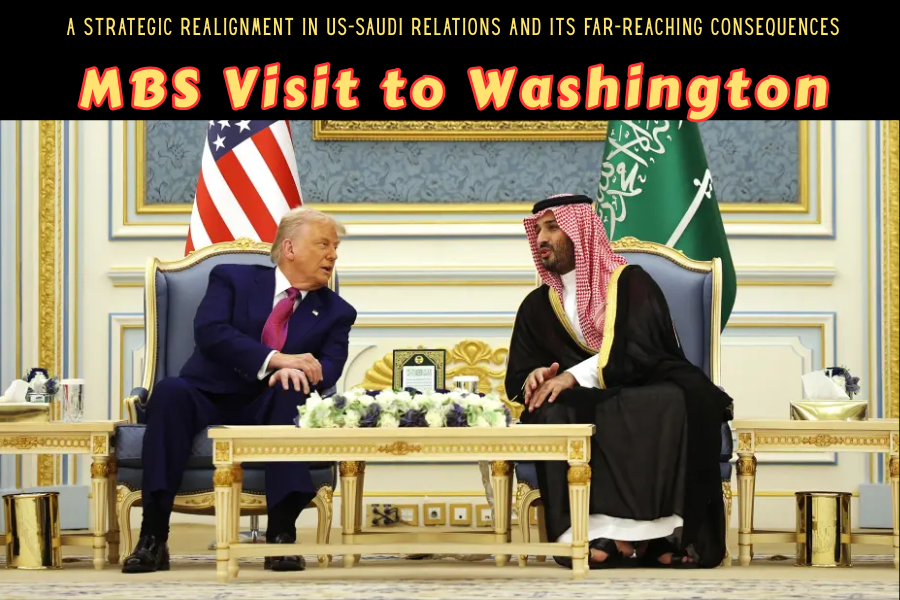
The two-day visit of Saudi Crown Prince Mohammed bin Salman (MBS) to Washington, culminating on 19 November 2025, will be recorded as one of the most consequential diplomatic events in the modern history of US–Gulf relations. Against the backdrop of a red-carpet welcome, fighter-jet flyover, and a black-tie dinner attended by global business icons, the United States and Saudi Arabia signed a Strategic Defence Agreement and confirmed the largest single arms package ever offered to an Arab state: up to 48 F-35A Lightning II stealth fighters, 300 M1A2 SEPv3 Abrams tanks, and associated munitions and training worth approximately $142 billion. This high-stakes diplomacy, blending oil wealth, military might, and tech ambitions, promises to reshape the Middle East’s power dynamics—but not without sparking fears of an arms race, strained alliances, and lingering human rights shadows. .
1. Mohammed bin Salman: Biography and Domestic Transformation
Born 31 August 1985, Mohammed bin Salman is the eldest son of King Salman bin Abdulaziz and his third wife, Fahda bint Falah Al Hithlain. A law graduate of King Saud University, he entered public life as an adviser to his father when the latter was governor of Riyadh. His rapid ascent began in January 2015 when King Salman assumed the throne and appointed him Minister of Defence at age 29 — at the time the youngest defence minister in the world.
In June 2017 he was named Crown Prince, displacing his cousin Mohammed bin Nayef in a carefully orchestrated succession change. Since then he has accumulated the titles of Deputy Prime Minister (2017), Prime Minister (2022), and Chairman of the Council of Economic and Development Affairs.
Domestically, MBS has pursued Vision 2030, an ambitious program to diversify the economy away from oil, attract foreign direct investment, and modernize social norms. Landmark reforms include:
- Lifting the ban on women driving (2018)
- Curtailing the religious police
- Opening cinemas and mixed-gender entertainment
- Mega-projects such as NEOM, Qiddiya, and the Red Sea tourism corridor
- Partial IPO of Saudi Aramco (2019)
These changes have been accompanied by a significant centralization of power, large-scale anti-corruption arrests in 2017–2018, and restrictions on dissent.
2. The Rollercoaster of US–Saudi Relations (2017–2025)
| Period | US Administration | Tone toward Riyadh | Key Events |
|---|---|---|---|
| 2017–2020 | Trump I | Strong personal rapport | $110 bn arms package (2017); Khashoggi murder (Oct 2018); muted US response |
| 2021–2024 | Biden | “Pariah state” rhetoric; arms freeze | Yemen offensive-weapon suspension; OPEC+ oil cuts (2022) |
| 2025–present | Trump II | Full strategic embrace | May 2025 Riyadh summit ($600 bn investment pledge); November 2025 Washington summit |
The Khashoggi assassination in October 2018 remains the single largest stain on MBS’s international image. A 2021 U.S. intelligence report assessed that the Crown Prince approved the operation. The Biden administration responded with sanctions on lower-level operatives and a pause on “offensive” arms sales, but stopped short of personal penalties on MBS himself — a recognition of Saudi Arabia’s enduring strategic weight.
President Trump’s return in 2025 dramatically reversed that chill. During his May 2025 visit to Riyadh he announced a $600 billion Saudi investment framework in U.S. infrastructure, AI, and energy, and laid the groundwork for the defence package finalized this week.
3. The November 2025 Agreements: What Was Actually Signed
| Agreement / Commitment | Details | Strategic Significance |
|---|---|---|
| Strategic Defence Agreement (SDA) | Executive agreement (no Senate ratification); designates Saudi Arabia Major Non-NATO Ally | Immediate access to advanced systems; “burden-sharing” fund to offset U.S. costs |
| F-35A Lightning II | Up to 48 aircraft (Block 4 standard) | First fifth-generation fighter in Arab hands |
| M1A2 SEPv3 Abrams tanks | 300 units + logistics and training package | Major upgrade over current Saudi fleet |
| Total arms value | ~$142 billion over 10–12 years | Largest single approved package to an Arab state |
| Investment pledge upgrade | Raised from $600 bn (May) to $1 trillion over the decade | AI data centers, civil nuclear, mining, defence industries |
| Civilian nuclear cooperation framework | U.S. support for Saudi nuclear power program under strict safeguards | Potential regional fuel-cycle arrangements |
Notably absent: a formal mutual defence treaty requiring Senate approval. The White House opted for an executive agreement to bypass congressional opposition.
4. Regional and Global Consequences
a. Balance of Power with Iran
The F-35s and upgraded tanks significantly enhance Saudi deterrent and power-projection capabilities. Combined with existing Typhoon, F-15SA, and AWACS fleets, the Royal Saudi Air Force will achieve information and air superiority over most regional adversaries for the first time. This strengthens Riyadh’s hand in Yemen and sends a clear message to Tehran and its proxies.
b. Israel and Qualitative Military Edge (QME)
U.S. law mandates that Israel retain a qualitative military edge over any combination of Arab states. The transfer has therefore triggered intense behind-the-scenes negotiations. Reported U.S. concessions to Israel include:
- Additional squadron of F-35I “Adir” with enhanced Israeli avionics
- Possible future transfer of B-21 Raider stealth bombers
- Continued funding for Arrow-3, David’s Sling, and Iron Dome enhancements
Saudi officials insist the aircraft will not be used against Israel and point to joint concerns over Iran. Nonetheless, the transfer ends the era in which Israel possessed an absolute fifth-generation monopoly in the region.
c. Palestinian Issue and Possible Normalization
MBS has publicly tied full normalization to an “irreversible path” toward a Palestinian state — a harder line than the UAE or Bahrain took in 2020. The new military leverage gives Riyadh greater ability to extract concessions from both Washington and Tel Aviv. Analysts expect Saudi financial participation in Gaza reconstruction to be part of any future deal, potentially under a revived Arab Peace Initiative framework.
d. Broader Muslim World
Pakistan, Malaysia, Indonesia, and Egypt have all expressed interest in deeper defence industrial cooperation with Riyadh. The sight of a Muslim power acquiring the same frontline U.S. systems previously reserved for close Western allies has undeniable symbolic resonance across the Islamic world.
e. Risk Factors
- Potential for a regional arms race (Qatar, UAE, and Turkey have already inquired about F-35s)
- Concerns over technology diversion (Saudi Arabia maintains extensive military and economic ties with China)
- Domestic U.S. criticism over human rights and the Yemen war
- Uncertainty whether Congress will appropriate the full funding in future budgets
5. Conclusion: A New Strategic Reality
The November 2025 visit marks the definitive end of the post-Khashoggi chill and the beginning of a new phase in which Saudi Arabia is treated — openly and unapologetically — as a tier-one U.S. partner. The transfer of F-35s and Abrams tanks is not merely an arms sale; it is a public acknowledgment that the center of gravity in the Arab and Islamic world now lies in Riyadh, not Cairo, Baghdad, or Damascus.
Whether this new reality produces greater stability through deterrence, or heightened tension through competition, will depend on how skillfully Washington, Riyadh, and other regional capitals manage the transition. For now, one fact is indisputable: the strategic map of the Middle East has been redrawn, and the Kingdom of Saudi Arabia sits at its center with capabilities it has never possessed before.
The choices made in the coming months — on Palestine, Yemen, Iran, and economic cooperation — will determine whether this historic realignment becomes a foundation for lasting peace or merely the prelude to a new and more dangerous chapter.