(By Khalid Masood)
I. Introduction
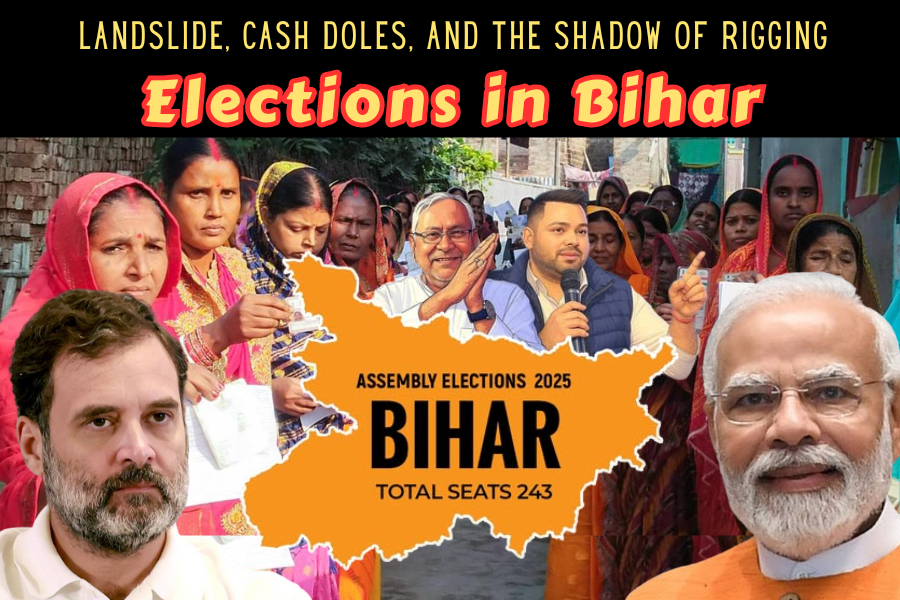
On the morning of November 14, 2025, Patna’s counting centers turned into theatres of disbelief. As the NDA’s tally surged past 200 seats, shell-shocked RJD workers gathered outside the strong rooms shouting “EVM chor hain!” In Muzaffarpur, an elderly woman—her calloused hands clutching a State Bank passbook—summed up the election with brutal honesty:
“Das hazaar aaya, vote diya.”
(Ten thousand rupees came, so I voted.)
Thus emerged the real story of the 2025 Bihar Assembly Elections: not a routine democratic contest but a masterclass in state-sponsored inducement, coercion without overt violence, voter-roll surgery, and a strategic silence on national security issues that once dominated Indian politics.
The NDA’s sweeping victory—hailed by Indian media as a “historic mandate”—was in fact the culmination of three interconnected forces:
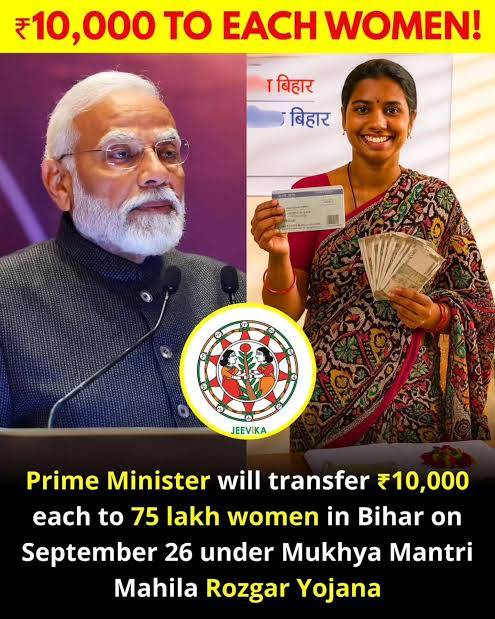
- The ₹10,000 cash transfer to nearly 7.5 million women, timed with surgical precision weeks before the Model Code of Conduct.
- Pre-poll voter list manipulation, particularly in Muslim-concentrated districts.
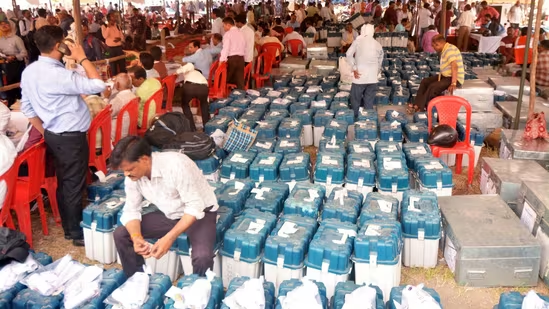
- Election-day engineering involving selective power outages, depowered CCTV cameras, and questionable turnout surges.
This article examines the evolution of politics in Bihar, the anatomy of the 2025 “cash blitz,” reported malpractices, and the broader implications on Indian democracy— where India’s electoral claims are frequently contrasted against its rhetoric of regional superiority.
II. Evolution of Bihar’s Politics: From Congress Fortress to NDA Cash Machine
Bihar’s political history is a pendulum swinging between identity politics, anti-incumbency waves, and welfare populism.
From Congress to Mandal Politics
Post-1947, Bihar remained a Congress bastion, governed through a tight matrix of upper-caste patronage, landholding power structures, and centralized control. The death of Sri Krishna Sinha in 1961 triggered fragmentation, paving the way for the JP Movement of the 1970s.
By the 1990s, Lalu Prasad Yadav rode the Mandal wave, galvanizing the MY (Muslim–Yadav) combination into an invincible social coalition. His reign—styled as empowerment by supporters and “Jungle Raj” by opponents—altered the caste calculus permanently.
The Nitish–BJP Era (2005–2020)
The 2005 elections ended Lalu’s 15-year run. Nitish Kumar, backed by BJP, recast himself as the architect of “development,” blending road-building with targeted caste appeasement.
The Shift to DBT Politics (2020–2025)
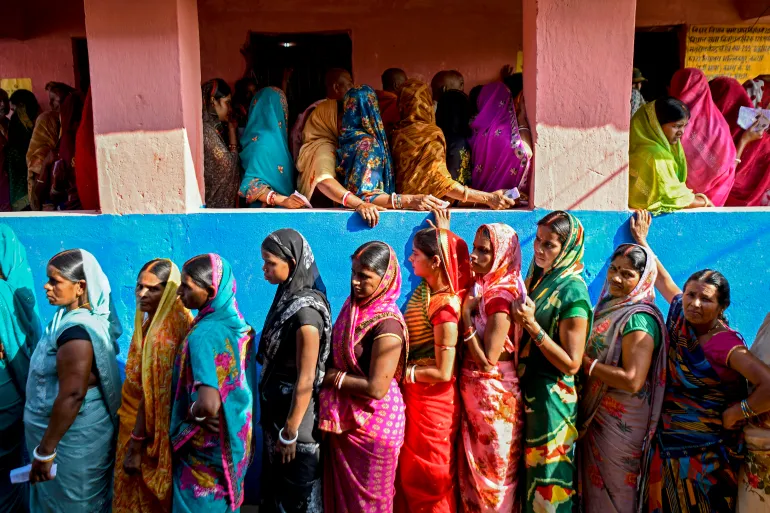
By 2025, identity-based mobilization began yielding diminishing returns. The NDA recalibrated its strategy toward Direct Benefit Transfer (DBT) politics, explicitly targeting women—whose turnout hit 71.6%, the highest ever.
The NDA’s winning formula became a four-pillar coalition:
- Women beneficiaries → transformed into a disciplined, politically grateful bloc.
- Extremely Backward Classes (EBCs) → consolidated through Nitish’s micro-schemes.
- Upper castes → remained BJP’s unwavering backbone.
- Muslims → divided between RJD and AIMIM, weakening opposition consolidation.
In short, Bihar has transitioned from caste loyalty → to cash loyalty.
III. Pre-Poll Rigging: The ₹10,000 Cash Bomb & Voter List Surgery
A. The ₹10,000 Women’s Transfer Scheme
The Mukhyamantri Mahila Rojgar Yojana became the election’s turning point. The schedule of disbursement alone reveals the electoral engineering:
- Sept 25: ₹2,500 crore transferred to 2.5 million women
- Oct 3: ₹2,500 crore to another 2.5 million
- Oct 8: Final tranche, completing ~7.5 million beneficiaries
- Model Code of Conduct imposed days later
The opposition cried foul:
- Rahul Gandhi called it “a government-sponsored bribe.”
- Prashant Kishor alleged diversion of a ₹14,000 crore World Bank loan.
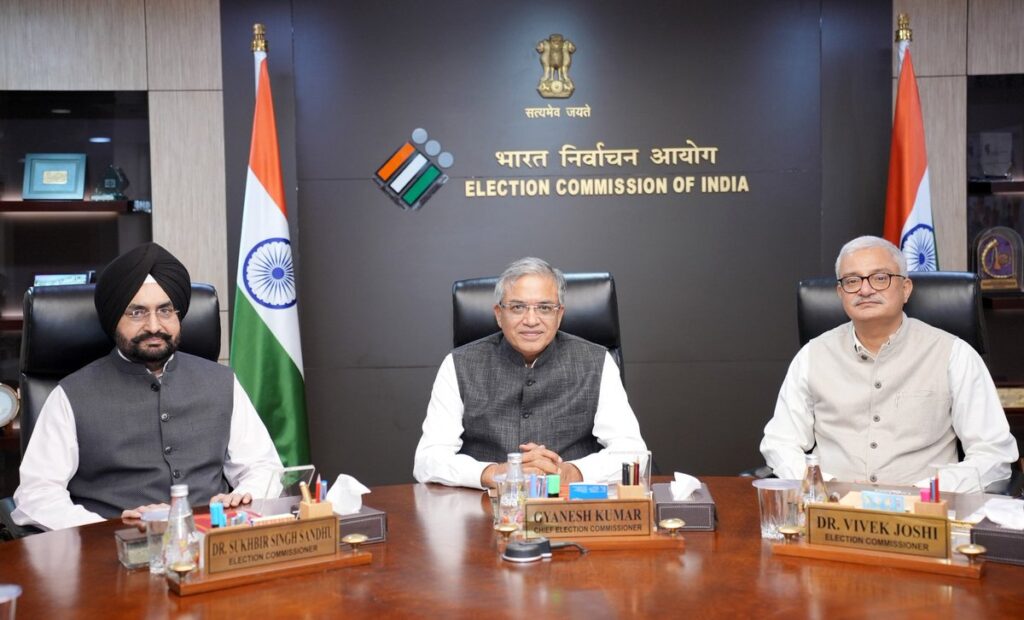
- Congress filed complaints with the Election Commission (ECI), which responded with ritualistic silence.
Impact on Voting Patterns
Women’s vote swing for NDA increased by 12% from 2020, especially in rural belts where ₹10,000 represented a month’s income for many.
B. Voter List Manipulation (SIR 2025)
A sophisticated operation preceded the polls—Strategic Inclusion & Removal (SIR 2025), as referred to by Congress analysts.
District-wise deletions:
| District | Voters Deleted | NDA Margin < Deletion |
|---|---|---|
| Seemanchal | 2.1 lakh | 11 seats |
| Patna | 1.5 lakh | 5 seats |
| Bhagalpur | 98,000 | 3 seats |
Out of the 12 lakh voters removed, over 60% were Muslim or OBC, disproportionately affecting opposition strongholds.
The ECI’s explanation—“routine cleanup”—was dismissed as superficial. No public audit was conducted.
C. Booth-Level Micro-Management
The BJP’s Panna Pramukh system assigned one worker per 60 voters, ensuring hyper-local surveillance.
Meanwhile, opposition alleged:
- Cash distribution ranging from ₹500–₹2,000 per voter.
- Covert pressure on village-level influencers.
IV. Election Day: Blackouts, Bogus Voting & EVM Whispers
Reports from monitoring groups and journalists revealed a disturbing pattern:
| Irregularity | Reported Instances | Key Locations |
|---|---|---|
| Power outages at strong rooms | 47 | Patna, Gaya |
| CCTV failures | 112 booths | Seemanchal |
| >100% reported polling | 11 villages | Madhubani, Supaul |
| Bogus voting videos | 8 viral clips | Darbhanga, Kaimur |
While RJD called this “Booth Capturing 2.0,” the ECI labeled them “isolated incidents” and limited VVPAT audits to just 5% of booths.
V. Results: Landslide on Paper, Razor-Thin in Reality
Final Seat Tally:
| Alliance | Seats | Vote % | Strike Rate |
|---|---|---|---|
| NDA | 202 | 44.2% | 83% |
| Mahagathbandhan | 38 | 31.8% | 22% |
| Jan Suraaj | 0 | 14.1% | 0% |
Close Contests (42 seats won by <1,000 votes)
A revealing correlation emerges:
| Seat | Winner Margin | Women Voter % |
|---|---|---|
| Sandesh | 87 | 74% |
| Imamganj | 213 | 71% |
| Tarari | 498 | 73% |
In 28 of these 42 seats, more than 60% of women had received the ₹10,000 transfer.
A mere 10% beneficiary swing could flip the seat.
VI. Congress Leadership’s Meltdown
Congress reacted with unfiltered rage:
- Rahul Gandhi: “Bihar was not an election—it was a transaction. He alleged that the Bihar election results reflect large-scale vote theft, calling the manipulated mandate unacceptable.”
- Kharge accused ECI of becoming “ECI-BJP.”
- Priyanka Gandhi mocked the one-time transfer: “Give ₹2,500 monthly if you care so much.”
- Sachin Pilot threatened Supreme Court action demanding a voter list audit.
The Kerala Congress Unit published a 62-page report showing:
- 1.2 million deletions exceeded NDA victory margins in 68 seats.
Calls for Rahul’s removal resurfaced, signaling a party on the edge of collapse.

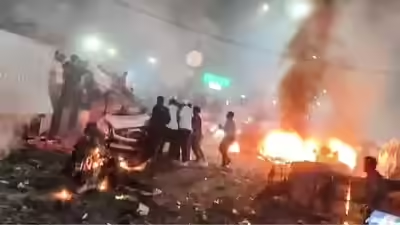
VII. The Blasts & Pakistan’s Vanishing Act
The Incidents
| Date | Location | Casualties | Claimed By |
|---|---|---|---|
| Nov 10 | Delhi (Red Fort) | 13 dead | Unclaimed |
| Nov 11 | Kashmir | 8 Policemen +1 Civilian | Unclaimed |
Why Pakistan Was Not Blamed
For the first time in years, India did not drag Pakistan into its political narrative.
Reasons:
- Ceasefire stability after 2025 clashes.
- India learnt that Pakistan is at par with them in conventional war. Intimidating or threatening Pakistan will fail and may be counter-productive.
- Backchannel dialogue continuing quietly.
- Intelligence showed local radical modules, not cross-border involvement.
- BJP’s electoral messaging centered on development, women’s empowerment, and DBT, not national security.
Modi’s silence after the attacks, particularly striking compared to the 2019 Pulwama–Balakot template, indicates a profound shift:
Pakistan is no longer needed as an electoral bogeyman.
VIII. Future Outlook: NDA’s Bihar & India’s Democratic Health
Scenario Analysis
| Scenario | Likelihood | Trigger |
|---|---|---|
| NDA Hegemony | High | Nitish stable, Congress decline |
| Opposition Revival | Medium | SC orders voter audit |
| ECI Crisis | Rising | Multiple states demand reforms |
Analysis
- India’s democratic institutions—Election Commission, judiciary, media—show dangerous convergence with ruling party preferences.
- Cash-transfer politics now overrides caste and ideological mobilization.
- By 2029, DBT-driven loyalty may determine national outcomes, marginalizing real governance issues.
- Pakistan’s relevance in India’s electoral narrative is decreasing—not because hostilities have ended, but because internal manipulation has become a more potent tool than external enemies.
IX. Conclusion
The 2025 Bihar elections were not stolen in the dead of night through violence or overt fraud—they were bought in broad daylight, methodically and unapologetically. Bihar has moved from Lalu Yadav’s caste arithmetic to Modi–Nitish’s cash arithmetic.
The larger question for Indian democracy is chilling:
If elections can be secured through last-minute cash doles and silent voter deletions, who will guard the guards?