(By Quratulain Khalid)
Introduction
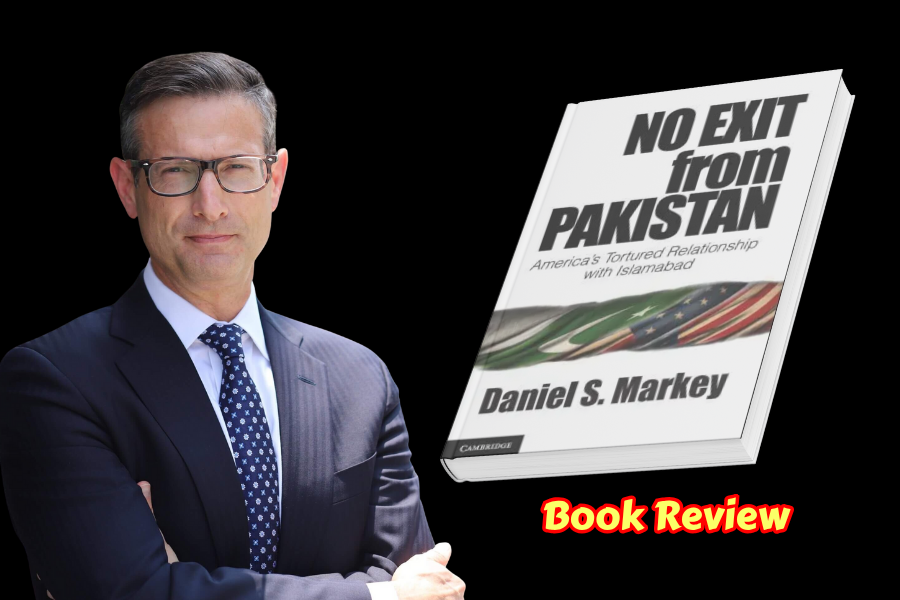
Published in 2013, No Exit from Pakistan: America’s Tortured Relationship with Islamabad by Daniel S. Markey offers a penetrating analysis of the fraught U.S.-Pakistan relationship, a dynamic central to global security. Drawing on his experience as a Council on Foreign Relations (CFR) senior fellow and former U.S. State Department official, Markey likens this partnership to Jean-Paul Sartre’s play No Exit, where characters are trapped in eternal mutual torment. For instance, U.S.-Pakistan ties have oscillated between alliance and animosity since Pakistan’s founding in 1947, marked by cooperation during the Cold War and tensions post-9/11. Consequently, Pakistan’s nuclear arsenal, growing population, and ties with China and India keep it on America’s geostrategic radar. Moreover, internal challenges like corruption and extremism amplify its global significance. This book, therefore, serves as both a historical account and a policy guide, urging the U.S. to manage this relationship strategically. This review explores Markey’s arguments, strengths, weaknesses, and lessons for countries like Pakistan.
Historical Context
U.S.-Pakistan relations began with cautious alignment in 1947, driven by Cold War imperatives. For example, Pakistan joined U.S.-led alliances like SEATO to counter Soviet influence, receiving military aid. However, tensions emerged over Pakistan’s nuclear ambitions and U.S. sanctions in the 1990s. The 2001 9/11 attacks reset the relationship, with Pakistan becoming a frontline ally in the War on Terror. Yet, mutual distrust persisted. For instance, the 2011 U.S. raid on Osama bin Laden in Abbottabad strained ties, as Pakistan felt violated, while the U.S. questioned its ally’s reliability. Markey’s book, published in 2013, captures this post-9/11 period up to 2012, before events like the 2014 Peshawar school attack or the 2021 U.S. Afghanistan withdrawal. Thus, it provides a snapshot of a critical yet dated moment in bilateral relations.
Themes and Content
The central theme is the inescapable interdependence of the U.S. and Pakistan. Markey argues that Pakistan’s internal issues—corrupt elites, economic instability, and extremism—threaten global security. For example, he highlights Pakistan’s nuclear arsenal and its ties with China as U.S. concerns. Moreover, he traces anti-American sentiment in Pakistan to historical grievances, like U.S. sanctions and perceived abandonment post-Soviet withdrawal from Afghanistan. Consequently, both nations are locked in a cycle of mutual frustration, unable to fully disengage.
Another key theme is strategic options for the U.S. Markey proposes three approaches: defensive insulation (mitigating Pakistan-based threats), military-first cooperation (supporting Pakistan’s military), and comprehensive cooperation (engaging civilian and military sectors). For instance, he advocates preparing for the worst while aiming for mutual benefit. Additionally, the book examines regional dynamics, particularly China’s growing influence and India-Pakistan tensions, which shape U.S. policy. Thus, it offers a nuanced framework for navigating this complex relationship.
Strengths
Markey’s book excels in its clarity and depth. His prose is accessible yet sophisticated, making complex diplomacy engaging. For example, a Goodreads reviewer praises its “succinct overview” of U.S.-Pakistan ties from the 1950s to 2012, ideal for geopolitics novices. Moreover, Markey’s insider perspective, drawn from his State Department role, adds credibility. He uses official documents, interviews, and news articles to craft a balanced narrative, as noted by Military Review’s Andrew Roe, who calls it “the best book” on the subject.
Additionally, the book’s regional analysis is a strength. Markey’s discussion of China’s moderating role in U.S.-Pakistan spats, highlighted by Jane Perlez in the New York Times, offers fresh insights. For instance, he notes Beijing’s advice to Pakistan post-bin Laden to negotiate with the U.S. Furthermore, his three strategic options provide practical guidance for policymakers, earning praise from American Diplomacy for its “cogent” post-9/11 analysis. Thus, the book is both informative and actionable.
Weaknesses
However, the book has limitations. Its 2013 publication makes it dated, as a Goodreads reviewer notes, missing events like the 2014 Peshawar attack or the 2021 U.S. Afghanistan withdrawal. For example, Markey’s skepticism of Pakistan’s fear of U.S. abandonment in Afghanistan proved inaccurate. Moreover, his predictive analysis is weak, with a reviewer stating, “predictions and forecast are not the forte of the author.”
Additionally, Markey’s U.S.-centric perspective can feel one-sided. For instance, he emphasizes Pakistan’s reliance on U.S. aid but underplays U.S. strategic interests, like countering China. A Pakistani reviewer on Medium felt this overlooked Pakistan’s agency, though they appreciated Markey’s honesty. Furthermore, the book’s focus on elite dynamics may neglect grassroots perspectives. Thus, its scope, while thorough, is not exhaustive.
Target Audience and Impact
No Exit from Pakistan is ideal for students, policymakers, and enthusiasts of diplomacy and South Asian geopolitics. For example, its clear structure suits those new to the subject, while its policy proposals appeal to experts. A CFR review notes its appeal to “academics, diplomats, and strategists.” Moreover, its 3.5/5 Goodreads rating reflects a solid reception, though limited reviews suggest niche appeal.
The book has shaped discussions on U.S.-Pakistan policy, influencing works like the CFR’s 2010 Task Force Report, which Markey directed. For instance, its emphasis on managing, not solving, the relationship resonates in academic and policy circles. However, its datedness limits its current relevance, especially post-2021. Nevertheless, it remains a key text for understanding bilateral dynamics.
Comparison to Similar Works
Compared to Vali Nasr’s The Dispensable Nation, Markey’s book is less focused on U.S. policy failures but broader in historical scope. For instance, Nasr critiques Obama’s retreat, while Markey examines decades of engagement. Similarly, Mark Mazzetti’s The Way of the Knife offers an insider CIA perspective, unlike Markey’s diplomatic focus. No Exit stands out for its Sartrean metaphor and strategic options, offering a unique lens on a complex alliance.
Lessons for Third World Countries
For third world countries like Pakistan, No Exit from Pakistan offers critical lessons on navigating great power relations. Specifically, Markey highlights the risks of over-reliance on foreign aid, as Pakistan’s addiction to U.S. funds limited its autonomy. For example, countries can prioritize domestic reforms to reduce elite corruption and economic instability, fostering self-reliance. Moreover, the book underscores the importance of balancing relations with rival powers, like China and India, to avoid being pawns in geopolitical games. However, resource constraints and internal challenges, such as Pakistan’s low tax-to-GDP ratio, complicate implementation. Thus, adopting strategic diplomacy and investing in civil society could enhance stability and global standing.
Final Verdict
No Exit from Pakistan is a compelling analysis of a tortured bilateral relationship. Markey’s clear prose, insider insights, and strategic proposals make it a must-read. For instance, its regional focus and historical depth enrich understanding. However, its datedness and U.S.-centric lens limit its scope. For readers seeking to grasp U.S.-Pakistan dynamics and diplomatic statecraft, it’s highly valuable. Thus, it earns a strong recommendation.
Rating: 3.8/5
Recommendation: Ideal for students, policymakers, and readers interested in diplomacy, South Asian geopolitics, and U.S. foreign policy.